How to Build Discipline Without Motivation: 7 Methods That Work
To build discipline without motivation, stop waiting to feel ready and build a system instead: start with a tiny version of the habit, tie it to a fixed trigger, design your environment, and never miss twice. Learning how to build discipline is the most important skill you will ever develop.
Every small promise you keep builds self-trust. We explain how in why self-discipline is the highest form of self-respect.
Motivation is unreliable. It feels great on a Monday morning with a strong coffee, a good playlist and big plans. Then Tuesday arrives, the feeling is gone, and the habit dies with it.
Waiting for motivation before you build discipline is like waiting until you’re thirsty to dig a well. By the time you need it, it’s already too late.
Discipline works better when it doesn’t depend on how you feel: a set of routines that run whether you’re energized or exhausted. You can build those routines, and this article shows how.
Below are 7 proven methods to build discipline that work even on your worst days. Each one is practical and grounded in behavioral research.

Small daily actions add up to real discipline over time.
In this guide
- Why Motivation Fails When You Try to Build Discipline
- The Real Definition of Discipline
- How to Build Discipline Without Motivation: 7 Powerful Methods
- The Discipline Stack: How to Chain These Methods Together
- Common Mistakes That Kill Discipline Before It Starts
- Start Today. Not Tomorrow.
- Discipline vs Motivation: Which Is Better?
- How to Build Discipline in 30 Days
- Do I Have ADHD or Do I Lack Discipline?
- Frequently Asked Questions
Why Motivation Fails When You Try to Build Discipline
Motivation is a feeling, and feelings come and go. Your mood shifts with sleep, stress, food, and a dozen other things you do not control. In plain terms: how you feel today is a poor guide to whether you’ll show up tomorrow.
Discipline works differently. Where motivation asks “do I feel like doing this?” discipline asks “is it time to do this?” Motivation depends on your mood; discipline depends on your routines.
People who are consistent over years rarely rely on feeling motivated. They set up their environment and routines so they need it less. That’s what the methods below aim for.
The Real Definition of Discipline
Discipline is not punishment. It is not white-knuckling through discomfort. It is not some personality trait you either have or you don’t.
If the uncomfortable part is what you keep avoiding, our 7 lessons on doing hard things are a good next read.
Discipline is the consistent execution of chosen behaviors regardless of emotional state.
James Clear argues in Atomic Habits (2018) that the most durable change comes from identity rather than motivation or willpower. When you see yourself as a certain type of person, your actions align accordingly. Someone who sees themselves as a runner goes running even on days they don’t feel like it, because that’s who they are.
That shift, from “I’m trying to be disciplined” to “I am a disciplined person,” is the foundation everything else is built on.
How to Build Discipline Without Motivation: 7 Powerful Methods
1. Start Embarrassingly Small
The most common reason discipline fails in the first week is that people start too big. A two-hour workout plan when you haven’t exercised in months. Writing 2,000 words a day when you haven’t written in years. The gap between where you are and where you want to be creates friction. Friction kills follow-through.
BJ Fogg, behavioral scientist at Stanford University and author of Tiny Habits (2019), found that reducing the size of a behavior dramatically increases the likelihood of it becoming automatic. His research showed that habits as small as “floss one tooth” successfully anchored larger dental hygiene routines.
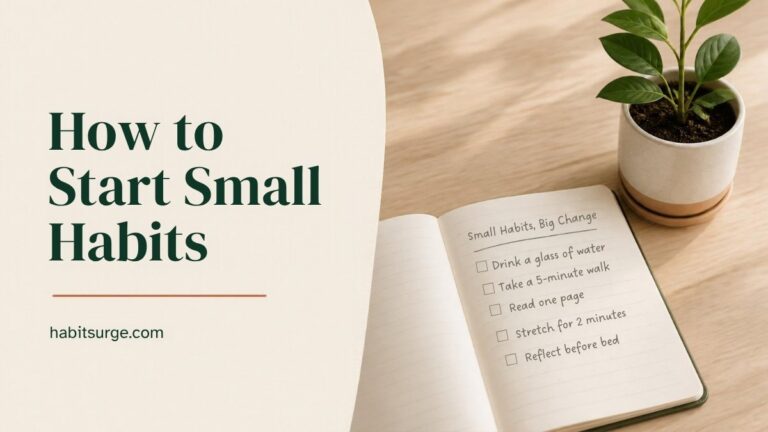
The rule: make the starting behavior so small it feels almost stupid. Two minutes of reading, five push-ups, one paragraph. The point is showing up, because showing up repeatedly is what changes how you see yourself. Here is how to start small habits that actually stick.
2. Design Your Environment
Your environment shapes your behavior more than your willpower ever will. A diary study by Wendy Wood, Jeffrey Quinn and Deborah Kashy, published in the Journal of Personality and Social Psychology (2002), found that about 43% of daily behaviors were performed habitually, usually in the same location.
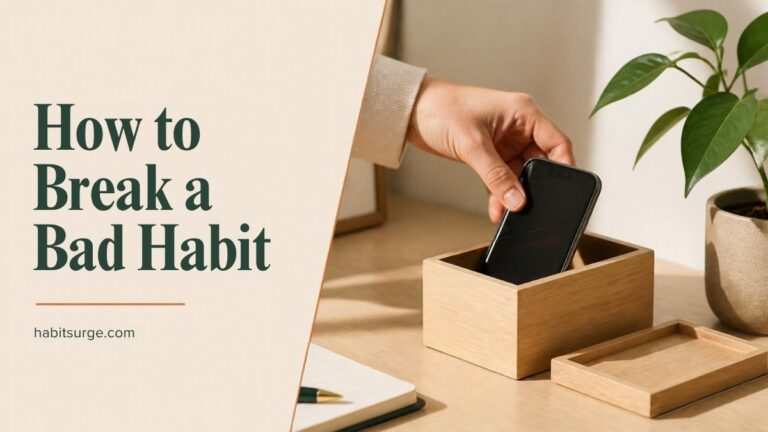
What this means practically: stop relying on willpower and start engineering your surroundings. Want to read more? Put the book on your pillow. Want to stop scrolling? Delete social media apps from your home screen. Want to work out in the morning? Sleep in your gym clothes.
Reduce friction for behaviors you want. Increase friction for behaviors you don’t. Your future self will follow the path of least resistance. Make sure that path leads somewhere worth going.
3. Use Implementation Intentions
An implementation intention is a specific plan that links a situation to a behavior. The formula is: “When X happens, I will do Y.”
Psychologist Peter Gollwitzer at New York University has studied implementation intentions for over two decades. A 2006 meta-analysis of 94 independent studies by Gollwitzer and Sheeran found that implementation intentions had a medium-to-large effect on goal attainment compared with simply setting a goal.
Instead of saying “I’ll work out more,” say “When I finish my morning coffee, I will put on my shoes and do 10 push-ups.” The specificity removes the decision. No decision means no negotiation with your tired, unmotivated brain.
Implementation intentions are one of the most research-backed ways to build discipline without relying on how you feel.
4. Track Your Streaks
Visual progress is a powerful motivator on the days when nothing else is. Jerry Seinfeld famously used a wall calendar to track his daily writing habit. Every day he wrote, he drew a red X. The growing chain of Xs became the motivation. “Don’t break the chain.”
A 2016 meta-analysis in Psychological Bulletin covering 138 studies found that monitoring your progress reliably improves goal attainment, especially when the progress is physically recorded (Harkin et al., 2016). The act of recording progress creates a feedback loop that reinforces the identity of being someone who shows up consistently.
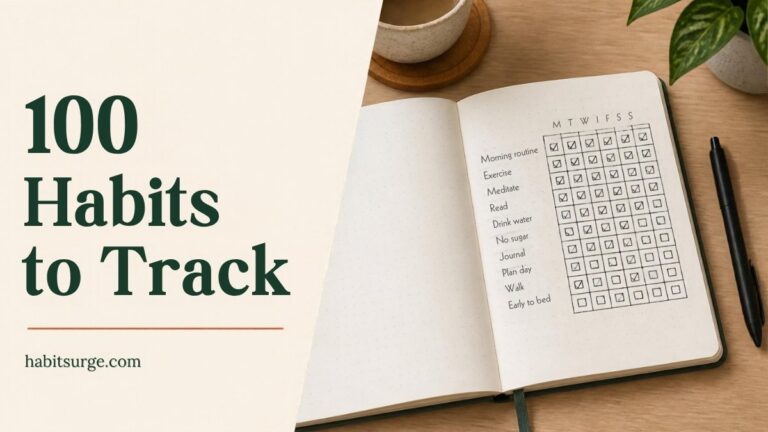
Use a habit tracker app, a paper calendar, or a simple notebook. What you track, you improve. What you visualize, you protect. For a full system, see how to be consistent even when you don’t feel like it.
5. Build an Identity Around the Behavior
This is the most powerful shift in this entire article. Every behavior change that sticks eventually becomes an identity statement.
There is a fundamental difference between “I’m trying to quit smoking” and “I’m not a smoker.” The first is a goal; the second is an identity, and people tend to protect their identity in a way they don’t protect goals.
James Clear writes in Atomic Habits (2018): “The most practical way to change who you are is to change what you do. Each time you write a page, you are a writer. Each time you practice the violin, you are a musician. Each time you start a workout, you are an athlete.”
Start casting votes for the person you want to become. Every small action is a vote. Enough votes and the identity becomes real.
6. Use Temptation Bundling
Temptation bundling is the practice of pairing a behavior you need to do with a behavior you want to do.
Katherine Milkman, behavioral economist at the Wharton School of the University of Pennsylvania, coined the term in a 2014 study published in Management Science. Her research found that gym attendance increased significantly when participants were only allowed to listen to their favorite audiobooks while exercising.
The formula: only do X (something you enjoy) while doing Y (something you need to do). Only listen to your favorite podcast while cleaning. Only watch your favorite show while folding laundry. Only enjoy your best coffee while working on your hardest task. You train your brain to associate discipline with reward.
Temptation bundling makes it easier to build discipline by removing the emotional resistance that kills most habits.
7. Accept That You Will Fail and Plan for It
The most underrated discipline strategy is planning for failure before it happens.
Perfectionism destroys more habits than laziness ever could. The belief that missing one day means you’ve failed leads to the “what the hell” effect, a term coined by researchers Janet Polivy and C. Peter Herman at the University of Toronto. Their research showed that when dieters broke their eating plan once, they were significantly more likely to abandon it entirely rather than simply continue.
The antidote is simple: never miss twice. Missing once is an accident; missing twice starts a new pattern. Build the rule into your system before you need it. “If I miss a workout, I do 10 minutes the next day no matter what.” A small act of recovery keeps the habit, and your sense of yourself, intact. Quitting early usually happens for predictable reasons. Here is why habits break on day 4 and the fix.
The Discipline Stack: How to Chain These Methods Together
These seven methods are not meant to be used one at a time. They compound. Here is a practical 30-day implementation stack to get you started:
Week 1: Environment and Identity
Redesign one environment to support your target behavior. Write down one identity statement: “I am someone who ___.” Say it every morning.
Week 2: Start Small and Track
Choose one habit. Make it embarrassingly small. Begin tracking on a physical calendar or app. Focus entirely on not breaking the chain.
Week 3: Add Intentions and Bundling
Write out your implementation intention for your habit. Identify one enjoyable activity to bundle with it. Execute daily.
Week 4: Plan for Failure
Write down your recovery rule. What will you do the day after you miss? Keep it simple and doable, and write it down.
After 30 days the behavior is no longer a goal. It is part of who you are.
Common Mistakes That Kill Discipline Before It Starts
Going too hard too fast. Starting at 100% intensity guarantees burnout. The research on habit formation from Phillippa Lally at University College London (published in the European Journal of Social Psychology, 2010) found that habits take an average of 66 days to become automatic, not the commonly cited 21. Slow down and plan for months, not weeks.
Relying on motivation as fuel. As covered above, motivation is an emotion. Build systems that don’t require it. The moment you stop needing motivation to act is the moment you’ve built real discipline.
No accountability structure. Discipline built in private is fragile. Discipline built with accountability is durable. Find one person, a friend, a coach, or an online community, who knows your commitment and checks in on your progress.
Skipping the identity work. You can have perfect systems and still fail if your self-image hasn’t caught up. Each time you follow through, it’s a small vote for the person you’re becoming, and over time the way you see yourself shifts.
Start Today. Not Tomorrow.
You don’t need motivation to build discipline. You need a decision and a system.
Pick one method from this list and start it today, not Monday.
The version of you who is disciplined didn’t feel more motivated than you do right now. They just started before they felt ready and kept going after the feeling passed.
Show up, build the system, and give it time.
Ready to go deeper? The free 7-Day Discipline Reset sends you one small action a day for a week.
Discipline vs Motivation: Which Is Better?
Discipline is more reliable. Motivation is a feeling that rises and falls. Discipline is a set of systems, triggers, and habits that keep running when the feeling is gone.
Motivation is still useful. It is a great spark for starting. But it is a poor engine for continuing. Use motivation to set up your systems on a good day, then let the systems carry you on the bad days.
How to Build Discipline in 30 Days
Thirty days will not make a habit fully automatic. Research suggests that takes about 66 days on average. But 30 days is enough to build the base. Follow the 4-week Discipline Stack above, focus on one habit only, and judge yourself on showing up, not on results. For the months after that, read how to stay disciplined once the novelty wears off.
Do I Have ADHD or Do I Lack Discipline?
Only a qualified professional can answer that. But some signs suggest it is more than discipline: struggles that started in childhood, show up across many areas of life, and stay even when you care deeply and use good systems. ADHD affects executive functions like starting tasks and working memory, which is a brain-based difference, not a character flaw.
If that sounds familiar, talk to a doctor or licensed clinician. In the meantime, the methods in this article, especially tiny starting steps and environment design, tend to help because they rely less on memory and willpower. This is general information, not medical advice.
Go deeper: Read the complete guide on how to build habits that stick, and learn how to stay disciplined when the excitement wears off.
More practical guides: habit stacking with 40 examples, 100 habits to track, and how to get back on track after you fall off.
Want a simple way to put this into practice? Try the 30-day self-improvement challenge: one small task a day for a month, with a free printable checklist.
Frequently Asked Questions
How long does it take to build discipline?
Research from University College London published in the European Journal of Social Psychology (2010) found that new behaviors take an average of 66 days to become automatic, though this varies from 18 to 254 days depending on the person and the complexity of the behavior. Consistency matters far more than speed. The most effective way to build discipline is to start small, design your environment, and repeat daily.
Can anyone build discipline or is it a personality trait?
Discipline is a skill, not a fixed personality trait. Behavioral science research consistently shows that self-control and consistent behavior are learnable through systems design, environment engineering, and identity-based habit formation. It is not something you either have or you don’t.
What is the most effective method for building discipline?
The most research-supported method is implementation intentions combined with environment design. A 2006 meta-analysis by Gollwitzer and Sheeran covering 94 studies found that specific “if-then” planning had a medium-to-large effect on follow-through compared with general goal setting.
What should I do when I break my discipline streak?
Apply the “never miss twice” rule. Research on the “what the hell” effect by Polivy and Herman at the University of Toronto found that one lapse often leads to complete abandonment of a behavior. The solution is a pre-planned recovery response. Missing once is an accident. Missing twice becomes a pattern. Keep the recovery action small and non-negotiable.
Is motivation ever useful for building discipline?
Motivation can be useful as an initial spark to start a new behavior, but it is unreliable as a sustaining force. Research consistently shows that motivation fluctuates based on mood, sleep quality, stress levels, and dozens of other variables. Discipline built on motivation collapses when motivation disappears. Systems, identity, and environment are far more durable foundations.