How to Start Small Habits That Actually Stick
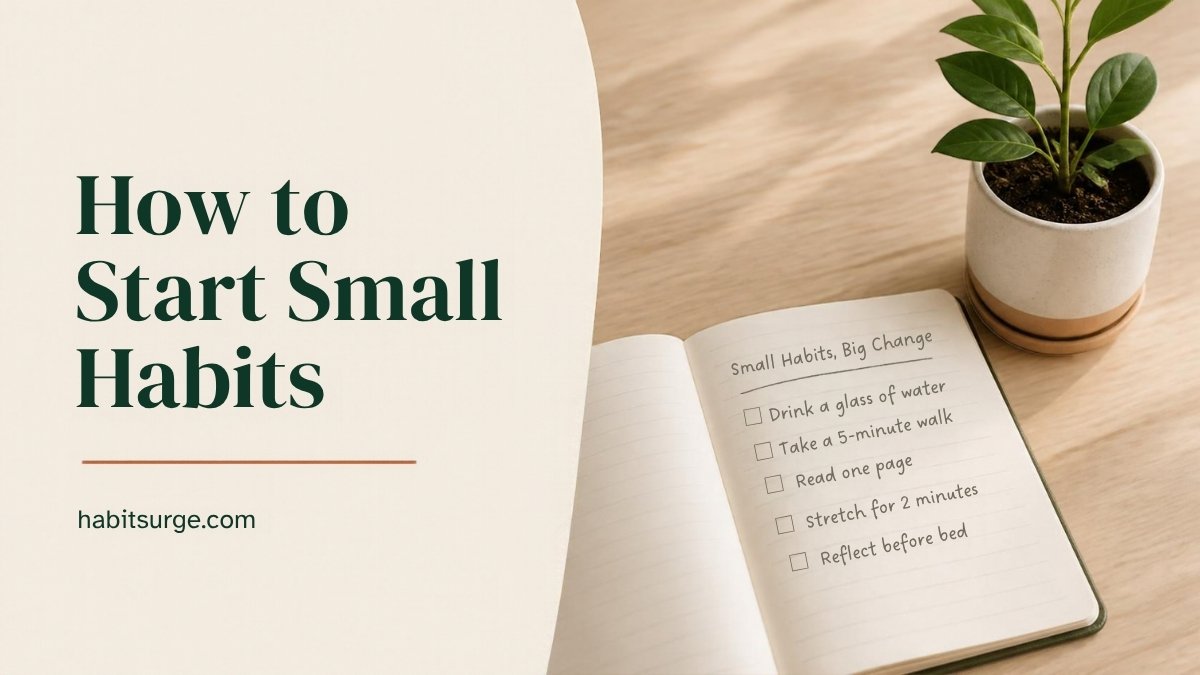
To start small habits that actually stick, shrink each habit until it takes under two minutes, attach it to something you already do every day, and count showing up as success. Once the tiny version is automatic, grow it gradually.
Not sure which habit to shrink first? Our list of 50 healthy habits to start today is sorted by body, mind, sleep, money and relationships.
Every guide on building habits tells you to start small. Almost none of them tell you how small. So you pick 15 minutes of meditation, or 30 minutes of exercise, or a 2,000-word daily writing session, and you’re right back to the same problem. You’ve set a target, not a habit.
The difference is structural. Starting small is a design decision more than a mindset tip. And there’s a specific way to do it that almost no one explains correctly.
In this guide
- How Do You Start Small Habits That Actually Stick?
- How Do You Make a Habit Stick With Minimal Effort?
- How Small Is Small Enough When Starting a New Habit?
- What Is the 7-21-90 Rule for Habits?
- What Is the 3-3-3 Rule for Habits?
- Does Starting Small Really Build Lasting Habits?
- How to Start Small Habits When You Have ADHD or No Motivation
- What This Looks Like in Practice
- Small Habits, Big Results: Where to Go Next
- Frequently Asked Questions
How Do You Start Small Habits That Actually Stick?
To start small habits that actually stick, set the commitment at the floor: the smallest version of the behavior that still counts as doing it. Not the goal version. The floor. The action so small you can complete it on your worst day, with no time, no energy, and no motivation.
For examples of habits that are small enough, see these 10 tiny daily habits.
BJ Fogg at Stanford studied more than 40,000 participants and found that the most durable behavior change starts with actions so small they seem almost laughable, then grows from there (Fogg, 2019, Tiny Habits). The brain builds habit grooves through repetition, not intensity. Frequency is everything. Frequency requires showing up. Showing up requires a threshold low enough to clear every day, including the bad ones.
This is why most small habit attempts still fail: people set the bar at “reasonable” rather than at “guaranteed.” Reasonable fails on bad days. Guaranteed runs on all of them.
→ For the full framework: How to Build Habits That Stick: The Complete Soft Discipline Guide
How Do You Make a Habit Stick With Minimal Effort?
A habit sticks with minimal effort when it’s been reduced to a Minimum Viable Habit (MVH), the smallest version of the behavior that still counts. The MVH removes the two mechanisms that kill most habits: the cost-benefit calculation at initiation (“do I have the energy for this right now?”) and the shame spiral after a miss (“I only did 3 minutes instead of 20, so I failed”).
Neuroscientist Ann Graybiel at MIT found that habit neural encoding depends on repetition over time, not on the duration or intensity of individual instances (Graybiel, 2008, Annual Review of Neuroscience). The basal ganglia, the part of the brain that automates habits, responds to consistent cue-behavior-reward sequences. It doesn’t log duration. This means 80 days of 5-minute sessions builds stronger automaticity than 20 days of 30-minute sessions, even if the total time looks comparable. That is why learning how to be consistent matters more than any single big effort.
When the commitment is 2 minutes, you almost never fail. Every completion reinforces the identity: “I’m someone who does this.” That identity signal compounds over months into a habit that no longer requires effort to maintain.
How Small Is Small Enough When Starting a New Habit?
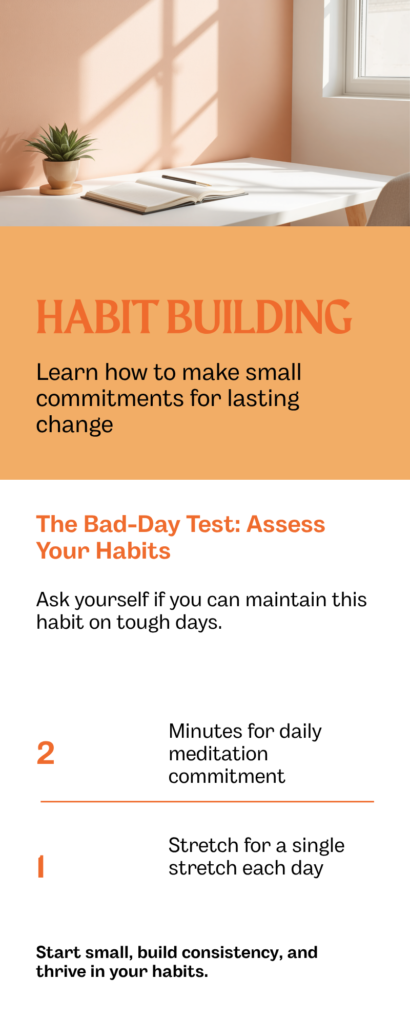
The answer: small enough to pass the bad-day test. Ask yourself: “On my absolute worst day, exhausted and short on time, could I still do this?” If the honest answer is yes, the commitment is set correctly. If it’s “probably,” shrink it further. This floor commitment (call it your minimum viable action) is the only version of the habit you’re responsible for hitting. Everything above it is discretionary.
The three-step method:
Step 1: Name the full habit you want. “I want to exercise every morning.”
Step 2: Ask: what’s the smallest version that still counts? “I could put on workout clothes and walk to the front door.” That counts.
Step 3: Apply the bad-day test. “On my worst day, could I put on workout clothes and walk to the front door?” Yes. That’s your MVH.
The commitment is exactly this much, not “at least this much.” The floor is the commitment. What happens after is up to you.
MVH Examples by Habit Type
| Habit Goal | Floor Commitment |
|---|---|
| Daily meditation | Sit in your spot for 2 minutes |
| Daily exercise | Put on workout clothes and walk to the front door |
| Daily reading | Open the book and read one page |
| Daily journaling | Write one sentence |
| Daily language learning | Complete one lesson |
| Daily stretching | Three deep breaths and one stretch |
| Daily gratitude | Say one thing out loud |
| Daily skincare | Complete the first step only |
Every MVH here takes 2–5 minutes. Every one is completable in the worst conditions. Every one genuinely counts as having done the habit.
Want a 7-day walkthrough of this method? The 7-Day Discipline Reset is a free PDF that walks you through setting your MVH floor for 3 habits, building your comeback protocol, and designing your environment, one day at a time. Download the 7-Day Discipline Reset →
What Is the 7-21-90 Rule for Habits?
The 7-21-90 rule suggests habits move through three phases: 7 days to initiate the behavior, 21 days to establish the routine, and 90 days to reach full automaticity. It’s a useful planning framework, but it only holds if the habit is designed to survive each phase.
The initiation phase (days 1–7) is where the MVH matters most. This is when the novelty dopamine spike is active and the behavior feels easy. The design mistake people make here is committing to the ambitious version while motivation is high, which then collapses in the establishment phase (days 8–21) when motivation normalizes. Research by Phillippa Lally at UCL tracked 96 participants over 12 weeks and found that automaticity (the point where a behavior runs without conscious effort) takes an average of 66 days, with a range of 18 to 254 days depending on the habit and person (Lally et al., 2010, European Journal of Social Psychology). The 90-day window accounts for this variance. The MVH is what keeps the habit running through the hard middle phase.
What Is the 3-3-3 Rule for Habits?
The 3-3-3 rule is a habit-building heuristic that recommends doing a new behavior for 3 days to start, 3 weeks to establish, and 3 months to lock in. Like the 7-21-90 rule, it’s a planning guide, and it has the same vulnerability: the commitment level set in days 1–3 is usually too high to survive weeks 2–3.
The MVH solves this directly. Set your 3-day commitment at the floor level, not the goal level. If you’re starting a reading habit, your 3-day commitment is one page, not 20 minutes. By the time you’re in week 3 and motivation has normalized, you’re not fighting to maintain a 20-minute commitment. You’re completing a one-page commitment that takes 90 seconds. The streak stays intact. The identity reinforcement happens every day.
Rules like 3-3-3 and 7-21-90 are useful for timeline expectations. The MVH is what makes the commitment actually survivable across those timelines.
Does Starting Small Really Build Lasting Habits?
Yes, and the reason is counterintuitive. Starting small builds lasting habits not by building willpower, but by replacing it. The goal of habit design is to get a behavior from “requires conscious decision” to “runs automatically.” Automaticity develops through repetition. Repetition requires completion. Completion requires a threshold the person can actually clear.
Psychologist Carol Dweck’s research on identity showed that “I am someone who meditates” is a more powerful behavior predictor than “I want to meditate regularly” because the identity statement doesn’t require any specific performance level to maintain (Dweck, 2006, Mindset). The MVH operationalizes this: when 2 minutes is the commitment, you succeed almost every day. Success reinforces the identity. The identity sustains the behavior when motivation is gone.
Starting small isn’t a consolation prize. It’s the mechanism by which large, automatic habits are eventually built.
→ Related: Why New Habits Fail to Stick: The Psychology Behind Day 4
How to Start Small Habits When You Have ADHD or No Motivation
Starting small habits is significantly harder with ADHD or chronically low motivation, for the same underlying reason: initiation. Getting started is the bottleneck, not continuation. The MVH targets this directly by reducing the initiation cost to near zero.
For low motivation: The cost-benefit calculation that kills initiation resolves easily when the commitment is 2 minutes. You may not want to do it, but the barrier is small enough that you start anyway. Starting is the hard part. The MVH eliminates it as a decision.
For ADHD: Executive function differences make behavioral initiation harder, not impossible. Specific applications:
- Set the MVH absurdly low: lower than feels necessary. “Open the notes app” is a valid journaling MVH. If it feels embarrassingly small, it’s probably right.
- Anchor to an existing behavior: after I pour coffee → I open my journal. The existing routine triggers the new one automatically, bypassing the need to remember or initiate independently.
- Put the object in your path: physical environmental cues do the remembering. A journal on the pillow doesn’t require recalling an intention; it requires moving the journal. ADHD brains respond to environment far better than to internal reminders.
- Plan for 90+ days: automaticity takes longer with ADHD. Build this expectation in from day one so early struggle doesn’t signal failure.
- Add external accountability: one person asking “did you do it?” outperforms internal motivation significantly. The MVH gives them something concrete to check.
→ Full guide: Habit Stacking: 40 Examples and a Simple Template
What This Looks Like in Practice
Daily meditation
- MVH: Sit in your spot for 2 minutes.
- Environment: Cushion in a fixed corner, same time each day.
- Comeback: “If I miss, I’ll sit for 2 minutes before bed that night.”
Daily movement
- MVH: Put on workout clothes and walk to the front door.
- Environment: Clothes on the bathroom counter the night before, shoes by the door.
- Comeback: “If I miss, I’ll do 5 jumping jacks the following morning. That counts.”
Daily writing
- MVH: Open the document and write one sentence.
- Environment: Document open in a pinned browser tab.
- Comeback: “If I miss, I’ll write one sentence at lunch the next day.”
When you miss (and you will), your comeback is not the full habit. It’s the MVH. Just the MVH. That’s the return. The Comeback Rule handles the rest.
→ Full guide: How to Get Back on Track After You Miss
Go deeper: Read the complete guide on how to build habits that stick, and learn how to stay disciplined when the excitement wears off.
Small Habits, Big Results: Where to Go Next
Need ideas for what to start? Browse 100 habits to track, then link your new habit to an existing one with habit stacking. When you slip, follow this 7-step reset to get back on track.
Want a simple way to put this into practice? Try the 30-day self-improvement challenge: one small task a day for a month, with a free printable checklist.
Frequently Asked Questions
How small should a habit be when you first start?
Small enough to pass the bad-day test: “On my absolute worst day, could I still do this?” If yes, the commitment is set correctly. For most habits, this means a single bounded action taking 2–5 minutes. If it feels almost too easy on normal days, you’ve set it right. The floor isn’t the goal. It’s the mechanism that keeps the streak intact when conditions aren’t ideal.
Why do most people fail when they try to start small habits?
Most people fail at starting small habits because they set “small” at the wrong level: reasonable instead of guaranteed. A 10-minute commitment feels small on a good day but fails on a bad one. The fix is setting the floor at the lowest version that still counts: one page, one sentence, two minutes. When the commitment is genuinely that small, bad days don’t break the streak. They just produce the minimum version.
Does the 3-3-3 rule actually work for building habits?
The 3-3-3 rule (3 days to start, 3 weeks to establish, 3 months to lock in) is a reasonable planning timeline. It works better when the commitment set in the first 3 days is a floor-level MVH rather than an ambitious goal. Research by Lally et al. (2010) found that automaticity takes an average of 66 days, and the 3-month window accounts for that. The timeline is sound. The problem is usually the commitment level, not the calendar.
Can you build multiple small habits at once?
Yes, but limit new habits to 2–3 at a time. Each new habit requires cognitive overhead during the early weeks while the loop is forming. Stacking more than three new habits simultaneously increases the chance that none establish properly. Build one solid habit, then add.
Does starting with a tiny habit work for ADHD?
Yes. The MVH works especially well for ADHD because it targets the initiation bottleneck directly. The lower the floor, the easier it is to start, and starting is often the hardest part for ADHD brains. Pair it with environmental cues so working memory is bypassed entirely, and plan for a 90+ day runway to automaticity. Early struggle is expected, not a failure signal.
References
- Dweck, C.S. (2006). Mindset: The New Psychology of Success. Random House.
- Fogg, B.J. (2019). Tiny Habits: The Small Changes That Change Everything. Houghton Mifflin Harcourt.
- Gollwitzer, P.M. (1999). Implementation intentions: Strong effects of simple plans. American Psychologist, 54(7), 493–503.
- Graybiel, A.M. (2008). Habits, rituals, and the evaluative brain. Annual Review of Neuroscience, 31, 359–387.
- Lally, P., van Jaarsveld, C.H.M., Potts, H.W.W., & Wardle, J. (2010). How are habits formed: Modelling habit formation in the real world. European Journal of Social Psychology, 40(6), 998–1009.
- Neal, D.T., Wood, W., & Quinn, J.M. (2006). Habits: A repeat performance. Current Directions in Psychological Science, 15(4), 198–202.
- Wood, W., & Neal, D.T. (2009). The habitual consumer. Journal of Consumer Psychology, 19(4), 579–592.