How to Stay Disciplined When the Excitement Wears Off
To stay disciplined long-term, lower the bar on hard days instead of quitting, build routines that run on triggers rather than mood, remove temptations from your space, review your progress weekly, and decide in advance what you will do when you slip. Starting is easy. Staying is the real skill.
For why this matters beyond willpower, see why self-discipline is the highest form of self-respect.
Almost everyone can be disciplined for a week. The first few days run on excitement. Then the novelty fades, life gets busy, and the plan quietly falls apart.
That is not a character flaw. It is a predictable phase. This guide is about getting through it.
In this guide
Why Is It So Hard to Stay Disciplined?
It is hard to stay disciplined because the reward for most good habits is delayed, while the reward for skipping them is immediate. Scrolling feels good now. Exercise pays off in months. Your brain naturally leans toward the reward it can feel today.
Four other things make it harder:
- The novelty wears off. Week one feels exciting. Week three feels like a chore.
- You built the plan for your best days. It breaks the first time you are tired, sick, or busy.
- Decisions pile up. If every day requires you to decide again, you will eventually decide no.
- One slip turns into a spiral. Missing one day leads to “I’ve already blown it.”
If you are still at the starting line, read how to build discipline without motivation first. This guide picks up where that one ends.
How to Stay Disciplined: 8 Strategies That Last
1. Lower the Bar, Never Remove It
The biggest threat to long-term discipline is the all-or-nothing mindset. On a hard day, people think they must either do the full routine or do nothing.
Pick a third option. Do a smaller version. A 10-minute walk instead of a 45-minute run. One page instead of a chapter. The habit stays alive, and so does your identity as someone who does it. Our guide on how to start small habits shows how small is small enough.
2. Run Your Day on Triggers, Not Moods
Tie each key habit to something that already happens every day. After coffee, journal. After lunch, a 10-minute walk. After closing the laptop, lay out tomorrow’s clothes.
Psychologists call these implementation intentions. A large meta-analysis found that “if-then” plans have a medium-to-large effect on reaching goals (Gollwitzer & Sheeran, 2006). The trigger does the remembering and the deciding for you.
3. Remove Temptation Instead of Resisting It
Discipline is easier when you do not have to use it. People who seem highly self-controlled often just set up their lives to face fewer temptations in the first place.
- Phone charging outside the bedroom
- No snacks at your desk
- Streaming apps logged out on weeknights
- Gym bag packed and in the car
Every temptation you remove is one less fight you have to win.
4. Make the Habit Part of Who You Are
“I’m trying to save money” is fragile. “I’m someone who doesn’t waste money” is sturdy. Identity-based habits last longer because quitting would mean acting against who you are.
Every small rep is evidence. The more evidence you collect, the more the identity holds you up on the days you feel nothing.
5. Review Your Week, Not Just Your Day
Daily tracking shows streaks. Weekly reviews show patterns. Every Sunday, ask three questions:
- What did I do consistently this week?
- Where did I slip, and what triggered it?
- What one small change will make next week easier?
A meta-analysis of 138 studies found that monitoring progress improves goal attainment, especially when progress is physically recorded (Harkin et al., 2016). Write it down.
6. Decide Your Recovery Rule in Advance
You will slip. Decide now what happens next.
The simplest rule: never miss twice. Missing once is normal. Missing twice is the start of a new pattern. The day after a slip, do the smallest version of the habit. No guilt. No making up for it. Just return.
Research on habit formation found that missing a single day did not meaningfully affect the process (Lally et al., 2010). The slip is not the problem. The quitting is.
7. Add Accountability
Tell one person what you are doing and when. Better yet, do it with them. A workout partner, a study buddy, or a weekly check-in text all raise the cost of skipping.
8. Protect Your Energy
Discipline gets much harder when you are exhausted. Sleep, food, and stress all affect how well you stick to plans. Put your hardest habits at the time of day you have the most energy, and keep your evenings simple.
For the full system behind these strategies, see our complete guide on how to build habits that stick.
What Are the Five Pillars of Discipline?
There is no single official list. A practical set of five pillars, based on habit research, looks like this:
- Clarity: knowing exactly what you will do and when.
- Simplicity: starting small enough to do it on bad days.
- Environment: setting up your space so the right choice is the easy one.
- Identity: seeing yourself as someone who does the thing.
- Recovery: having a plan for getting back on track after a slip.
How Do I Train Myself to Be Disciplined?
Train discipline the way you train a muscle: small, regular reps with gradual increases. Pick one habit. Make it tiny. Do it at the same time every day for two weeks. Then increase the size slightly, or add a second habit. If you need a place to start, pick one of these good daily habits.
Expect it to take a while. In the UCL study, new habits took a median of 66 days to become automatic (Lally et al., 2010). Here is how to be consistent through that stretch.
How to Stay Disciplined in Specific Areas
How to Stay Disciplined With Working Out
Schedule workouts like appointments, with a fixed day and time. Keep a minimum version for busy days, like 10 minutes of bodyweight exercises. New gym members who exercised at least four times a week for six weeks were more likely to form a lasting habit (Kaushal & Rhodes, 2015). Frequency beats intensity early on.
How to Stay Disciplined With Diet
Change your environment before you change your willpower. Keep the foods you want to eat visible and easy. Keep the foods you want to avoid out of the house. Plan meals before you are hungry, because hungry decisions are rarely good ones.
How to Stay Disciplined With Money
Automate it. Set savings and bill payments to happen automatically on payday so the decision is already made. Add a waiting rule for purchases, such as 48 hours for anything non-essential. Delete saved card details from shopping sites to add friction.
How to Stay Disciplined in College or Studies
Study at the same time and place each day. Use a timer for focused blocks, such as 25 minutes on and 5 off. Keep your phone in another room. On low days, open your notes and review one page. Showing up keeps the habit alive.
How to Stay Disciplined With ADHD
If you have ADHD, discipline strategies built on memory and willpower often fail. Lean on systems that work outside your head: visual cues, alarms, body doubling, and very small starting steps. If focus problems are affecting your daily life, talk with a doctor or licensed professional. This is general information, not medical advice.
How to Stay Disciplined: Quick Checklist
- Have a smaller version ready for hard days
- Tie every habit to a daily trigger
- Remove your biggest temptation from your space
- Review your week every Sunday
- Never miss twice
- Tell one person your plan
Want a guided start? Get the free 7-Day Discipline Reset. One small action a day to rebuild your routine. Get the free guide here.
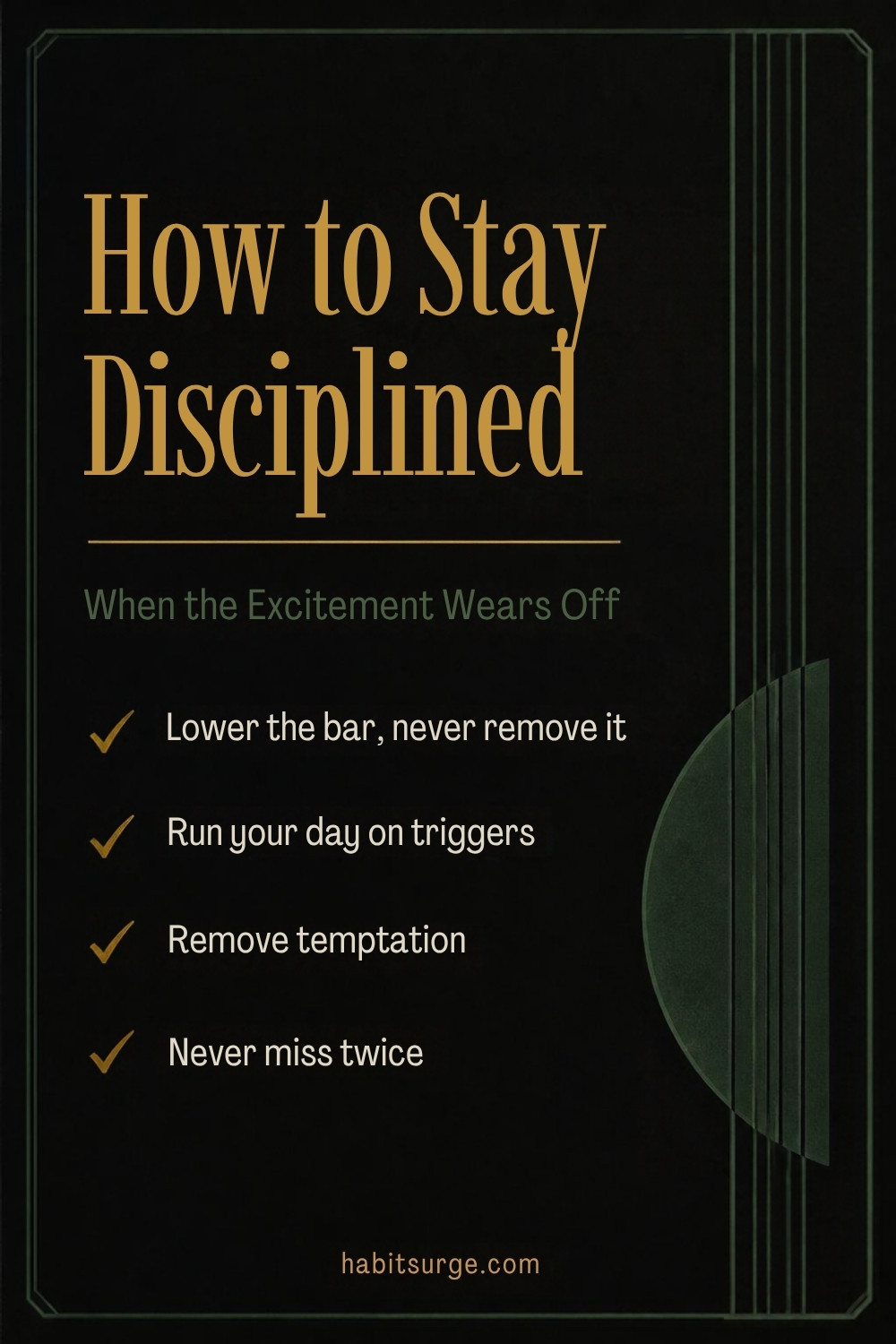
Save this for later: pin the image below to your Pinterest board.
More practical guides: habit stacking with 40 examples, 100 habits to track, and how to get back on track after you fall off.
Frequently Asked Questions
How do I stay disciplined when I have no motivation?
Rely on routines and triggers instead of feelings. Do the smallest version of your habit at its usual time. Motivation often shows up after you start, not before.
How long does it take to become disciplined?
Most habits take around two months to become automatic. A UCL study found a median of 66 days, ranging from 18 to 254 days depending on the person and the habit.
Why do I lose discipline after a few weeks?
Usually because the excitement fades and the plan was built for good days only. Shrink the habit, tie it to a trigger, and set a recovery rule so a slip does not become a stop.
Is it okay to take breaks from discipline?
Yes. Planned rest days are part of a sustainable routine. The key is that breaks are scheduled and short, not open-ended.
What is the best way to stay disciplined and consistent?
Make the habit small, automatic, and part of your identity. Track it, review it weekly, and never miss twice in a row.
References
- Gollwitzer, P. M., & Sheeran, P. (2006). Implementation intentions and goal achievement: A meta-analysis of effects and processes. Advances in Experimental Social Psychology, 38, 69–119.
- Harkin, B., Webb, T. L., Chang, B. P. I., et al. (2016). Does monitoring goal progress promote goal attainment? A meta-analysis of the experimental evidence. Psychological Bulletin, 142(2), 198–229.
- Kaushal, N., & Rhodes, R. E. (2015). Exercise habit formation in new gym members: A longitudinal study. Journal of Behavioral Medicine, 38(4), 652–663.
- Lally, P., van Jaarsveld, C. H. M., Potts, H. W. W., & Wardle, J. (2010). How are habits formed: Modelling habit formation in the real world. European Journal of Social Psychology, 40(6), 998–1009.