How to Be Consistent (Even When You Don’t Feel Like It): 9 Rules That Work
To be consistent, shrink the habit until it is easy on your worst day, attach it to a fixed time or trigger, track it visibly, and never miss twice in a row. Consistency is not a personality trait. It is a system that keeps working when your motivation does not.
If you struggle with consistency, you probably think you have a motivation problem. More often it’s a design problem. They set up habits that only work on good days, then blame themselves when a bad day shows up.
This guide gives you 9 rules to fix that. Each one is backed by behavioral research. Each one works on the days you feel nothing.
In this guide
- What Consistency Actually Means
- Why Do I Lack Consistency?
- How to Be Consistent: 9 Rules That Work
- How Do I Train Myself to Be Consistent? A 30-Day Plan
- How to Be Consistent in Specific Areas
- Do People With ADHD Struggle With Consistency?
- How to Stop Being Inconsistent: The Short Version
- Frequently Asked Questions
What Consistency Actually Means
Consistency means doing a chosen behavior repeatedly, at a predictable time, regardless of how you feel. It is not perfection. It is not a 365-day streak. It is a high average over a long period.
Someone who works out 4 times a week for a year is more consistent than someone who works out 7 days straight and then quits for a month. The first person built a pattern. The second person had a burst.
Here is the good news. Research from University College London found that missing a single day did not meaningfully hurt habit formation (Lally et al., 2010). You do not need a perfect record. You need to keep coming back.
Why Do I Lack Consistency?
Inconsistency usually comes down to one of five reasons. Find yours before you try to fix it.
- The habit is too big. A 60-minute workout is easy to skip. A 5-minute one is not.
- There is no fixed trigger. “I’ll do it later” means you will decide again every day. Every decision is a chance to say no.
- You rely on motivation. Motivation is a feeling, and feelings change by the hour.
- Your environment fights you. If your phone is next to you and your book is on a shelf, the phone wins.
- You quit after one miss. One skipped day turns into “I’ve already ruined it.” Psychologists call this the what-the-hell effect.
Every rule below targets one or more of these causes.
How to Be Consistent: 9 Rules That Work
1. Make It Easy on Your Worst Day
Set a minimum version of your habit so small you can do it while tired, stressed, or sick. Two minutes of reading. One push-up. One sentence in a journal.
This is your floor. On good days you do more. On bad days you do the floor and count it as a win. The streak survives either way.
Stanford behavior scientist BJ Fogg built his entire Tiny Habits method on this idea. Small behaviors are easier to repeat, and repetition is what makes them automatic. We cover this in depth in how to start small habits that actually stick.
2. Attach It to a Fixed Trigger
Do not schedule a habit for “sometime today.” Attach it to something you already do every day.
Use this formula: “After I [existing habit], I will [new habit].”
- After I pour my morning coffee, I will write three lines in my journal.
- After I close my laptop for the day, I will put on my walking shoes.
- After I brush my teeth at night, I will read one page.
This is called an implementation intention. A meta-analysis of 94 studies by Peter Gollwitzer and Paschal Sheeran found that if-then plans had a medium-to-large effect on goal achievement (Gollwitzer & Sheeran, 2006). The plan removes the daily decision. No decision means no negotiation.
3. Stop Waiting to Feel Ready
Consistent people do not feel more motivated than you. They just stopped asking how they feel before they start.
Action usually comes before motivation, not after it. Start the first 2 minutes. Momentum often shows up once you are moving. If it doesn’t, you still did the floor from Rule 1.
If this is your biggest struggle, read our full guide on how to build discipline without motivation. To keep it going over months, see how to stay disciplined when motivation fades.
4. Design Your Environment for the Habit
A large share of what you do every day is driven by habit and context, not conscious choice. One diary study found that roughly 43% of daily actions were performed habitually, usually in the same location (Wood, Quinn & Kashy, 2002).
So change the context:
- Make good habits visible. Put the book on your pillow, the water bottle on your desk and the gym bag by the door.
- Make bad habits harder. Charge your phone in another room, log out of social apps and keep snacks out of sight.
You are not trying to win a fight with yourself. You are removing the fight.
5. Follow the Never Miss Twice Rule
You will miss days. Plan for it now.
Missing once is an accident. Missing twice is the start of a new pattern. When you miss, your only job the next day is to do the floor version of the habit. Nothing more.
Do not try to make up for the missed day by doubling the work. That turns the habit into punishment, and people avoid punishment. Just return.
The first week is where most habits die. Here is why new habits fail around day 4 and how to fix it.
6. Track It Where You Can See It
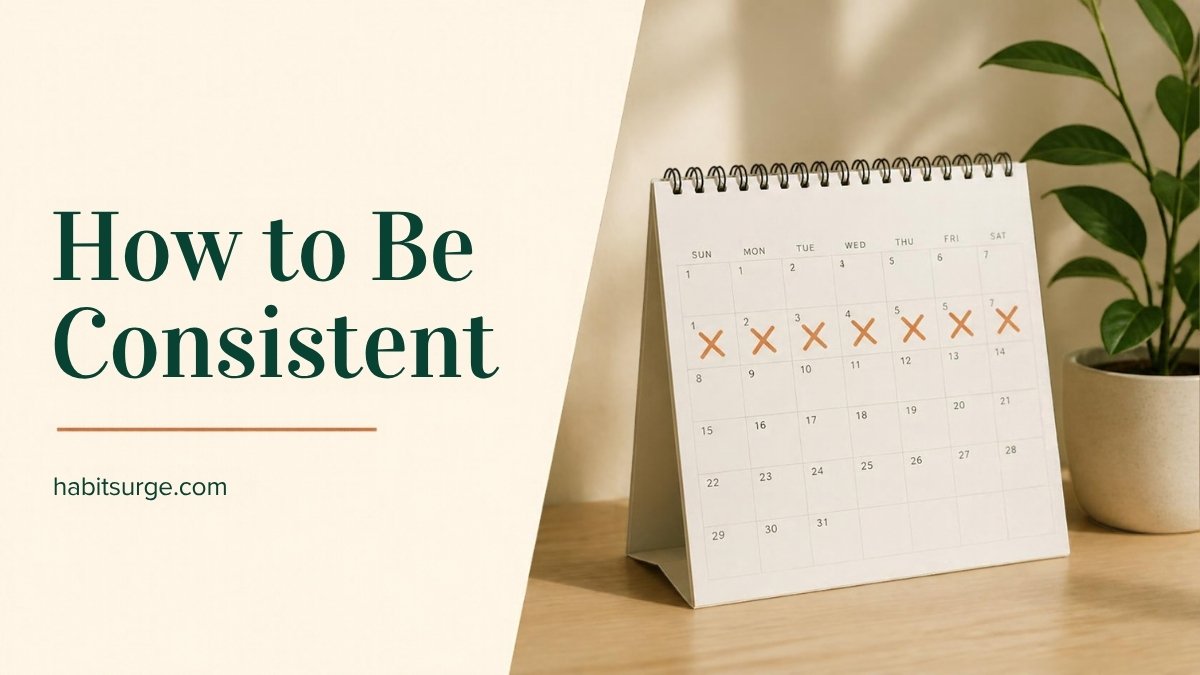
A visible record turns invisible effort into proof. Use a paper calendar, a habit tracker app, or a sticky note with tally marks.
Keep tracking simple: one checkmark per day. If tracking takes longer than 10 seconds, you will stop tracking.
The point is not the streak. The point is evidence. Every checkmark tells your brain: “I am someone who does this.”
7. Pair Hard Habits With Something You Enjoy
Researchers at Wharton tested this with gym-goers. People who could only access tempting audiobooks while at the gym visited more often than a control group (Milkman, Minson & Volpp, 2014). The method is called temptation bundling.
Try it:
- Only listen to your favorite podcast while walking.
- Only drink your best coffee while doing your hardest work.
- Only watch your favorite show while folding laundry or stretching.
8. Use Fresh Starts on Purpose
People are more likely to start new goals after “temporal landmarks” like a Monday, the first of the month, or a birthday (Dai, Milkman & Riis, 2014). This is the fresh start effect.
Use it to restart, not to delay. If you fell off, do not wait for January. The next Monday is a fresh start. So is tomorrow morning.
9. Build Identity, Not Just Goals
“I’m trying to work out more” is a goal. “I’m someone who moves every day” is an identity. Goals end; identities tend to stick around.
Every time you do the habit, even the floor version, you cast a vote for that identity. Enough votes and you stop needing to force it. It becomes who you are. We go deeper on this in why self-discipline is the highest form of self-respect.
How Do I Train Myself to Be Consistent? A 30-Day Plan
Do not try all 9 rules at once. Stack them week by week.
- Week 1: Pick one habit and set the floor. Write your minimum version. Attach it to a trigger using the “After I…” formula.
- Week 2: Fix your environment. Make the habit visible. Add friction to the main distraction. Start a simple tracker.
- Week 3: Plan for misses. Write your never-miss-twice rule. Add one temptation bundle.
- Week 4: Lock in the identity. Write one sentence: “I am someone who ___.” Read it every morning.
Expect it to take time. In the UCL study, habits took a median of 66 days to become automatic, with a range of 18 to 254 days (Lally et al., 2010). Thirty days builds the base. The next 30 make it stick.
How to Be Consistent in Specific Areas
How to Be Consistent With Working Out
Set a fixed schedule, not a fixed intensity. A study on new gym members found that people who exercised at least four times per week for six weeks were more likely to form a lasting exercise habit (Kaushal & Rhodes, 2015). Frequency mattered more than how hard each session was.
Floor version: put on workout clothes and move for 5 minutes.
How to Be Consistent in Life and Daily Routines
Start with one anchor habit, usually in the morning, and let others attach to it. A short routine you actually finish beats a perfect routine you skip. For ideas, see our list of tiny daily habits that transform your life.
How to Be Consistent With Studying
Study at the same time and place every day. Use a timer for 25 minutes. Keep your phone in another room. The floor version is opening your notes and reading one page.
Do People With ADHD Struggle With Consistency?
Many people with ADHD report that consistency is harder, largely because ADHD affects executive functions like starting tasks, planning, and working memory. That is a brain-based challenge, not a character flaw.
The rules above tend to help because they reduce reliance on memory and willpower. Visible cues, tiny starting steps, and fixed triggers do a lot of the work for you. External accountability, like a body double or a check-in partner, can also help.
If consistency problems affect your work, health, or relationships, talk to a doctor or licensed professional. This article is general information, not medical advice.
How to Stop Being Inconsistent: The Short Version
- Shrink the habit until it is easy on your worst day.
- Tie it to something you already do daily.
- Remove friction for the habit. Add friction to distractions.
- Track it with one checkmark a day.
- Never miss twice.
- Think “I am someone who…” not “I’m trying to…”
Want a done-for-you plan? Get the free 7-Day Discipline Reset. One small action a day, built on the rules above. Get the free guide here.
Go deeper: Read the complete guide on how to build habits that stick, and learn how to stay disciplined when the excitement wears off.
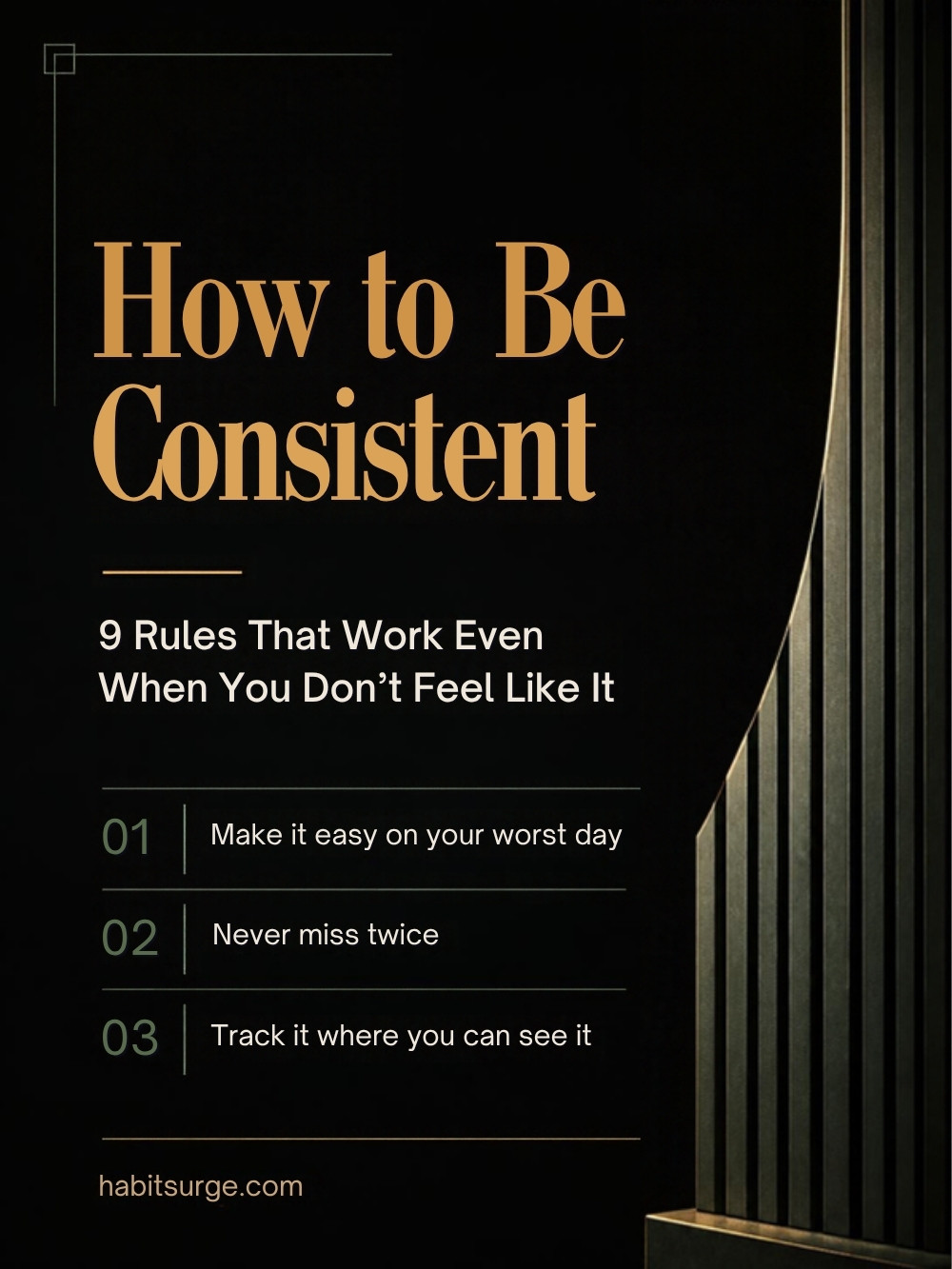
Save this for later: pin the image below to your Pinterest board.
More practical guides: habit stacking with 40 examples, 100 habits to track, and how to get back on track after you fall off.
Build your mornings: use this simple morning routine checklist for adults.
Want a simple way to put this into practice? Try the 30-day self-improvement challenge: one small task a day for a month, with a free printable checklist.
Frequently Asked Questions
How long does it take to become consistent?
Most habits take about two months to feel automatic. A UCL study found a median of 66 days, with a range of 18 to 254 days depending on the person and the habit. Simple habits form faster than complex ones.
Is consistency more important than intensity?
Yes, for building habits. Doing a small version often builds the habit faster than doing a large version rarely. Research on new exercisers found that frequency over the first six weeks predicted whether the habit lasted.
What should I do when I lose consistency?
Restart with the smallest version of the habit the very next day. Do not try to make up for lost days. Use the never-miss-twice rule and treat the next Monday or next morning as a fresh start.
Is consistency better than motivation?
Consistency is more reliable. Motivation is a feeling that rises and falls. Consistency comes from systems, triggers, and environment, which keep working when motivation is low.
How do I stay consistent when I’m tired?
Do the floor version only. Two minutes or one rep counts. The goal on tired days is to protect the pattern, not to make progress.
References
- Dai, H., Milkman, K. L., & Riis, J. (2014). The fresh start effect: Temporal landmarks motivate aspirational behavior. Management Science, 60(10), 2563–2582.
- Gollwitzer, P. M., & Sheeran, P. (2006). Implementation intentions and goal achievement: A meta-analysis of effects and processes. Advances in Experimental Social Psychology, 38, 69–119.
- Kaushal, N., & Rhodes, R. E. (2015). Exercise habit formation in new gym members: A longitudinal study. Journal of Behavioral Medicine, 38(4), 652–663.
- Lally, P., van Jaarsveld, C. H. M., Potts, H. W. W., & Wardle, J. (2010). How are habits formed: Modelling habit formation in the real world. European Journal of Social Psychology, 40(6), 998–1009.
- Milkman, K. L., Minson, J. A., & Volpp, K. G. M. (2014). Holding the Hunger Games hostage at the gym: An evaluation of temptation bundling. Management Science, 60(2), 283–299.
- Wood, W., Quinn, J. M., & Kashy, D. A. (2002). Habits in everyday life: Thought, emotion, and action. Journal of Personality and Social Psychology, 83(6), 1281–1297.