How to Break a Bad Habit: 10 Steps That Work (and Why Willpower Doesn’t)
To break a bad habit, find the cue that triggers it, make the habit harder to do, replace it with a new behavior that meets the same need, and plan in advance what you’ll do when the urge hits. Habits run on autopilot, so the fix is to change the situation, not to rely on willpower in the moment.
Most people try to break bad habits by sheer force: “I’m just not going to do it anymore.” It works for a day or two. Then a stressful afternoon arrives, the old habit kicks in, and they feel like they’ve failed.
That’s not a character flaw. It’s how habits work. Once you understand the mechanics, you can use them to your advantage. This guide walks you through 10 steps to break a bad habit, whether it’s nail biting, late-night snacking, endless scrolling or hitting snooze.
In this guide
How Habits Work (and Why They’re Hard to Break)
A habit is a behavior you repeat so often in the same situation that it becomes automatic. Researchers describe it as a link between a cue (a time, place, feeling or action) and a response. After enough repetition, the cue triggers the response without much conscious thought.
That’s why habits are so efficient, and so stubborn. Psychologists Wendy Wood and David Neal have shown that once a habit forms, behavior is driven more by the situation than by your goals or intentions. You can sincerely want to stop and still find yourself doing it, because the cue fires before your intentions catch up.
Every habit also pays off in some way. Snacking eases boredom. Scrolling relieves stress. Biting your nails releases tension. If you remove the habit without meeting that need another way, the urge stays and the habit comes back.
So breaking a bad habit has three parts: avoid or change the cue, make the old response harder, and give the need a new outlet.
10 Steps to Break a Bad Habit
1. Pick one habit to start with
Trying to fix five habits at once spreads your attention too thin. Choose the one that bothers you most or that triggers other bad habits. For example, late-night scrolling often leads to poor sleep, which leads to snacking and skipped workouts.
2. Write down exactly when it happens
For a few days, don’t try to change anything. Just notice. Every time you do the habit, note:
- Where you were
- What time it was
- What you were feeling
- Who you were with
- What you’d just done
Patterns appear fast. You might find you only bite your nails during video calls, or you only snack after 9 p.m. in front of the TV. Those details are your cues.
3. Figure out what the habit gives you
Ask honestly: what do I get from this? Relief from boredom? A break? Comfort? Connection? Stimulation? The answer tells you what the replacement needs to do. A replacement that doesn’t meet the need won’t last.
4. Change your environment
This is the most powerful step. Because habits are triggered by context, changing the context weakens the habit. Some examples:
- Snacking at night: don’t keep the snack in the house, or put it on a high shelf in an opaque container
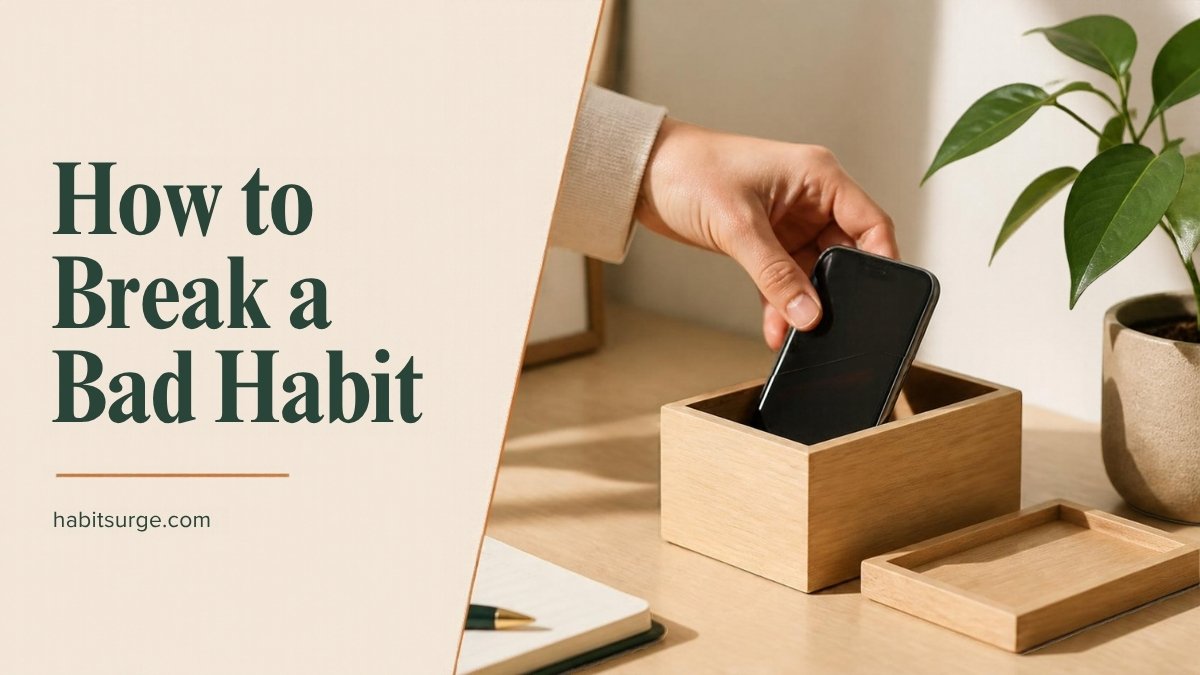
- Scrolling in bed: charge your phone outside the bedroom
- Nail biting: keep nails short, wear a bandage on your favorite finger, or keep a fidget toy at your desk
- Too much TV: unplug it after each use or move the remote to another room
The aim is to add friction to the bad habit. Even 20 seconds of extra effort can be enough to break the automatic loop.
5. Choose a replacement behavior
Don’t just stop. Swap. Pick a new behavior that fits the same cue and meets the same need:
- Stressed at your desk: take three slow breaths or a 2-minute walk instead of opening social media
- Bored at night: make herbal tea or do a short stretch instead of snacking
- Anxious in meetings: squeeze a stress ball instead of biting your nails
Make the replacement easy enough to do even on a bad day.
6. Make an if-then plan
Write your plan as a simple rule: “If [cue], then I will [replacement].” For example: “If I sit on the couch after dinner, then I’ll make a cup of tea.” Research on these plans, called implementation intentions, shows they help people act on their goals, including breaking unwanted habits, because the decision is made in advance rather than in the moment of temptation.
7. Use mindful noticing, not suppression
Trying hard not to think about something tends to make you think about it more. Instead of fighting the urge, notice it with curiosity: “There’s the urge. It feels tight in my chest. It’s getting stronger. Now it’s fading.” Urges usually rise and fall like a wave within a few minutes. In a study on quitting smoking, people who learned mindfulness techniques like this did better than those in a standard program.
8. Tell yourself “don’t” at the critical moment
This sounds too simple, but research by Jeffrey Quinn and colleagues found that vigilant monitoring, actively watching for the habit and thinking “don’t do it” when the cue appeared, was one of the more effective in-the-moment strategies for stopping strong habits. It works best combined with the environmental changes above.
9. Track your progress
Keep a simple record of each day you avoid the habit (or each time you use your replacement). Seeing a streak grow is motivating, and a log shows you which days are hardest. Our free habit tracker works well for this.
10. Plan for slip-ups
You will probably slip at least once. That’s normal, not a reason to quit. Decide now what you’ll do after a slip: notice what triggered it, adjust your plan, and get straight back on track. The rule that matters most is never miss twice. One slip is a blip. Two in a row starts a new pattern. If you’ve already fallen off, our 7-step reset can help.
How Long Does It Take to Break a Bad Habit?
There’s no fixed number. You may have heard “21 days”, but that figure isn’t based on solid research. A well-known study on forming new habits found that it took people a median of about 66 days for a new behavior to feel automatic, with a huge range from 18 to 254 days depending on the person and the habit.
Breaking a habit follows a similar pattern. The urges usually get weaker and less frequent over weeks to months, especially if you’ve changed your environment. Old habits can come back in old situations, though, so stay alert when you’re stressed, on holiday or back in a place where the habit used to happen.
Examples: How to Break Common Bad Habits
Hitting snooze
Put your alarm across the room, set it for the time you actually need to get up, and get light straight away. More tips in how to wake up early.
Phone checking and doom scrolling
Turn off nonessential notifications, move social apps off your home screen and keep your phone out of the bedroom. See our full guide on how to stop doom scrolling.
Procrastinating
Shrink the first step to two minutes and remove distractions before you start. More in how to stop procrastinating.
Late-night snacking
Close the kitchen after dinner by brushing your teeth, keep tempting snacks out of sight and replace the habit with tea or a short wind-down routine.
Nail biting
Keep nails short, use a bitter-tasting nail polish, and keep your hands busy with a fidget item during triggering moments like calls or TV.
When a Bad Habit Might Be Something More
This guide is for everyday habits. If a behavior involves alcohol, drugs, gambling, self-harm or disordered eating, or if you feel you can’t stop despite serious harm, please talk to a doctor or mental health professional. Those are health conditions that deserve proper support, and help works.
Frequently Asked Questions
What is the fastest way to break a bad habit?
The fastest way is to change your environment so the habit is harder to do, for example by removing the trigger or adding friction. Pair that with a replacement behavior and an if-then plan for the moment the urge appears.
Does it take 21 days to break a habit?
No. The 21-day idea isn’t backed by solid research. Studies on habit formation show it often takes around two months for a new behavior to feel automatic, with a wide range between people.
Why do I keep going back to bad habits?
Because the cue that triggers the habit is still there, and the need the habit meets hasn’t been met another way. Change the cue and choose a replacement that gives you the same benefit.
Is it better to replace a bad habit or just stop it?
Replacing it usually works better. Stopping leaves a gap, and the urge pulls you back to the old behavior. A replacement gives the cue a new, healthier response.
What should I do after a slip-up?
Treat it as information, not failure. Note what triggered it, adjust your plan and get back on track the same day or the next. Try never to miss twice in a row.
References
- Wood, W., & Neal, D. T. (2007). A new look at habits and the habit-goal interface. Psychological Review, 114(4), 843–863.
- Lally, P., van Jaarsveld, C. H. M., Potts, H. W. W., & Wardle, J. (2010). How are habits formed: Modelling habit formation in the real world. European Journal of Social Psychology, 40(6), 998–1009.
- Quinn, J. M., Pascoe, A., Wood, W., & Neal, D. T. (2010). Can’t control yourself? Monitor those bad habits. Personality and Social Psychology Bulletin, 36(4), 499–511.
- Adriaanse, M. A., Gollwitzer, P. M., De Ridder, D. T. D., de Wit, J. B. F., & Kroese, F. M. (2011). Breaking habits with implementation intentions: A test of underlying processes. Personality and Social Psychology Bulletin, 37(4), 502–513.
- Wegner, D. M., Schneider, D. J., Carter, S. R., & White, T. L. (1987). Paradoxical effects of thought suppression. Journal of Personality and Social Psychology, 53(1), 5–13.
- Brewer, J. A., Mallik, S., Babuscio, T. A., et al. (2011). Mindfulness training for smoking cessation: Results from a randomized controlled trial. Drug and Alcohol Dependence, 119(1–2), 72–80.