Why New Habits Fail to Stick: The Psychology Behind Day 4 (And the Fix)
New habits fail to stick mainly because they start too big, the environment never changes, one missed day triggers quitting, and the reward feels too far away. Each of these is a design problem, not a character flaw, and each has a simple fix below.
If you’ve ever started a new habit full of energy on Monday and found yourself back to your old patterns by Thursday, you’re not broken. Why do new habits fail to stick? Almost always, it isn’t a willpower problem. It’s a predictable pattern that hits around day three or four, and almost no one warns you about it before you start.
Understanding this pattern changes how you build every habit from here on.
In this guide
- Why Do New Habits Fail to Stick?
- What Is the Root Cause of Bad Habits Failing?
- What Happens in Your Brain When a New Habit Breaks?
- Do People With ADHD Struggle More With Building Habits?
- Why Do Most New Habits Fail Within Weeks Despite Good Intentions?
- How Do You Fix a Habit That Keeps Failing?
- What This Looks Like in Practice
- Why Are Habits So Hard to Break?
- Frequently Asked Questions
Why Do New Habits Fail to Stick?
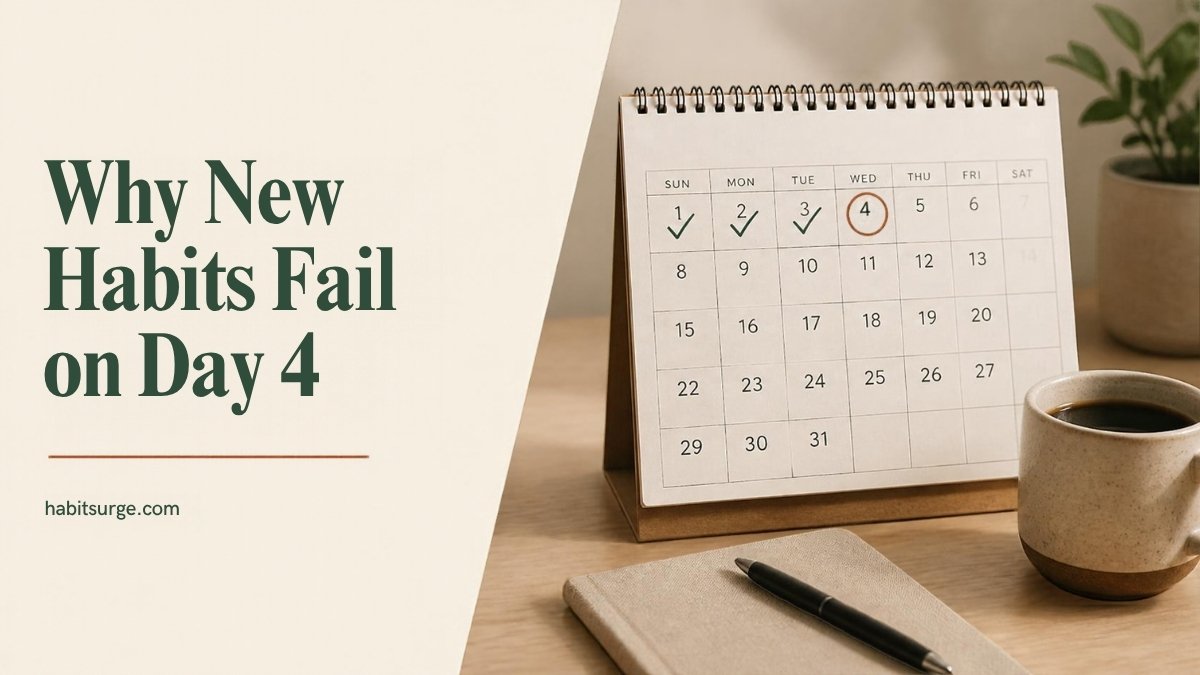
New habits fail to stick because the initial motivation is borrowed, not built. When you start a new behavior, a neurological boost from dopamine, the brain’s anticipation and reward chemical, makes the first few days feel effortless. By day three or four, that novelty spike flattens. The habit now has to stand on its own structural merits. If it wasn’t designed well, it breaks.
Researcher Phillippa Lally at University College London found that habits take an average of 66 days to become automatic, not the 21 days people often quote (Lally et al., 2010, European Journal of Social Psychology). Most people quit before the habit has any chance to form. The failure isn’t discipline. It’s design.
We call this the Honeymoon Cliff: the gap between borrowed excitement and real automaticity. What you discover on day four is what the habit was actually built on. If nothing is holding it up (no cue in your environment, no recovery plan, no sense of who you’re becoming), it breaks.
→ For the complete system: How to Build Habits That Stick: The Complete Soft Discipline Guide
What Is the Root Cause of Bad Habits Failing?
The root cause of new habits failing is a design problem, not a character problem. Research consistently shows that most habits break because of one or more of four specific structural failures: the commitment is too ambitious from the start, the environment fights the new behavior, there is no recovery protocol for missed days, and the reward is too far in the future to sustain motivation.
Each failure is fixable. None of them require more willpower.
Failure 1: The Commitment Was Too Big From Day One
You commit to meditating 20 minutes every morning. By day four, that commitment feels like a debt. Humans are wired to avoid things that feel like debts. Instead of running out of willpower to do the habit, you avoid it to protect your sense of competence. Failing at 20 minutes feels worse than not starting. So you don’t start.
The fix: reduce the commitment to something you can do on your worst day. Sit for 2 minutes. That’s the habit. Everything else is a bonus.
→ Full guide: The Minimum Viable Habit: Start So Small It Feels Ridiculous
Failure 2: The Environment Hasn’t Changed
Your environment is a behavior prediction machine. MIT neuroscientist Ann Graybiel demonstrated that habits are tied to context: the same cues that triggered old behaviors continue to trigger them unless deliberately changed (Graybiel, 2008, Annual Review of Neuroscience). Your phone next to your bed will pull you toward scrolling before your morning routine every single morning, regardless of your intentions.
You can’t outthink your environment. You can only redesign it.
→ Full guide: Habit Stacking: 40 Examples and a Simple Template
Failure 3: The First Miss Triggers Catastrophizing
Psychologists call it the abstinence violation effect: one lapse is interpreted as total failure, triggering complete abandonment (Marlatt & Gordon, 1985). You miss one workout. The thought arrives: “I already broke it. What’s the point?” One miss becomes two becomes “I’ll start Monday” becomes never.
The miss isn’t the problem. The story you tell about the miss is. Pre-planning your response to a missed day before you miss one is what stops this pattern.
→ Full guide: How to Get Back on Track After You Miss
Failure 4: The Reward Is Too Far Away
Habits with long-delayed payoffs, like exercise, eating well or learning a language, are neurologically harder to maintain. Wendy Wood’s research at USC confirms that habits are reinforced most strongly when paired with immediate, pleasurable outcomes, even small ones (Wood & Neal, 2009, Psychological Review). If your only reward for working out is “I’ll be healthier in 6 months,” your brain struggles to care today.
Pair the habit with something you already enjoy. Make that thing contingent on doing the habit.

What Happens in Your Brain When a New Habit Breaks?
When a new habit breaks, the dopamine system is adjusting to the absence of novelty. Dopamine neurons fire in response to unexpected rewards and new experiences. That’s why starting a habit feels exciting (Schultz, 1998, Science). By day three or four, the behavior is no longer novel. The dopamine spike flattens. The neurological free trial has ended.
What remains is the structural reality of how the habit was designed. Without environmental cues to trigger the behavior automatically, without a threshold low enough to clear on low-energy days, and without a recovery plan for missed days, the habit dissolves. You aren’t undisciplined. The design wasn’t built to last past the excitement.
Do People With ADHD Struggle More With Building Habits?
Yes. People with ADHD face significantly greater challenges when building new habits because of differences in dopamine regulation and executive function, the same systems that drive habit formation. The novelty window is shorter, the Honeymoon Cliff is steeper, and the abstinence violation effect hits harder because impulse control is also affected.
Executive function differences mean that working memory, initiation, and follow-through, which a new behavior depends on, are harder to access consistently. This is not a lack of effort or motivation. It’s a neurological difference in how the habit formation system operates.
What actually helps for ADHD and habits:
- Minimum Viable Action solves the initiation problem: the barrier to starting is near zero, which bypasses the executive function bottleneck
- Environmental design reduces reliance on working memory. The physical cue does the remembering so you don’t have to
- Longer runway: plan for 90+ days to automaticity, not 66; build this expectation in from day one so early struggles don’t signal failure
- External accountability: an accountability partner asking “did you do it?” works better than internal motivation alone
- Body doubling: working alongside another person, even virtually, significantly improves task initiation for many with ADHD
If you have ADHD, the same Soft Discipline framework applies. It just requires more environmental scaffolding and a longer expected timeline.
Why Do Most New Habits Fail Within Weeks Despite Good Intentions?
Most new habits fail within weeks despite good intentions because intention and design are not the same thing. Good intentions tell you what you want to do. Design determines whether you actually do it when conditions aren’t perfect. Research on implementation intentions (specific if-then plans) shows that people with clear action plans are significantly more likely to follow through than those with goals alone (Gollwitzer, 2009, Psychological Science).
“I want to exercise more” fails on a busy Tuesday. “I will do 5 minutes of movement every morning immediately after I make coffee” survives a busy Tuesday because it has a specific cue, a specific behavior, and a specific time. Intention without implementation structure is just a wish.
How Do You Fix a Habit That Keeps Failing?
To fix a habit that keeps failing, apply three structural changes before you restart: set a Minimum Viable Action as your daily floor, make one physical environmental change that reduces friction, and write a Comeback Protocol before you begin.
1. Minimum Viable Action (MVA)
The smallest version of the habit that still counts as doing it. Not the goal version. Not the ideal version. The floor. On hard days, you do this and nothing else. The streak stays intact. On good days, you do more, but you never committed to more.
2. One environmental change
One thing that makes the habit easier to start. One thing that makes the competing behavior harder. You don’t need a complete life overhaul. One physical change per habit is enough to shift the default behavior.
3. A written Comeback Protocol
Before you begin, write: “If I miss a day, I will _____ the following day.” The blank is just your MVA. Nothing punishing, and no doubling up. Just returning. The act of writing this before you start means you’ve already decided what to do when the streak breaks. It takes the decision, and the catastrophizing, out of the moment of failure. For more rules like this one, see how to be consistent.
These three things won’t make habit-building effortless. But they will get you past day four, which is where the majority of attempts end.
What This Looks Like in Practice
Reading before bed
- MVA: Read one page. That’s it.
- Environment: Book on the pillow, phone charging in another room.
- Comeback Protocol: “If I miss a night, I’ll read one page at breakfast the next day.”
Daily movement
- MVA: Put on workout clothes and step outside, even if you only walk to the mailbox.
- Environment: Shoes by the front door, workout clothes on the bathroom counter the night before.
- Comeback Protocol: “If I miss a day, I’ll do 5 jumping jacks the next morning. That counts.”
Morning journaling
- MVA: Write one sentence about how you’re feeling. Anything.
- Environment: Notebook open on the kitchen table, pen on top, visible with your morning coffee.
- Comeback Protocol: “If I miss a morning, I’ll write two sentences at lunch. Same entry.”
The specificity matters. Vague plans fail at the first inconvenience. Written, specific protocols survive it.
Go deeper: Read the complete guide on how to build habits that stick, and learn how to stay disciplined when the excitement wears off.
Why Are Habits So Hard to Break?
Old habits are hard to break because they run on cues, not decisions. Your brain links a trigger, like stress or a phone notification, to a familiar action and reward. Repeat that loop enough and it becomes automatic. Breaking it works best by changing the cue and the environment, not by relying on willpower alone.
To replace an old habit with a new one, link the new behavior to a daily anchor using habit stacking, and keep it tiny. If you have already fallen off, here is how to get back on track.
Frequently Asked Questions
Why do new habits fail to stick even when you’re motivated?
New habits fail to stick even with motivation because motivation is a temporary state, not a structural support. The dopamine novelty boost that makes the first days feel easy typically fades by day 3–4. Once it’s gone, only the design of the habit (its size, setup and recovery plan) decides whether it survives. Motivation helps you start. Design determines whether you continue.
What is the root cause of bad habits being hard to break?
The root cause of bad habits being hard to break is that they are deeply encoded environmental responses. Ann Graybiel’s research at MIT shows that habit circuits in the basal ganglia are very hard to erase. Old habit pathways go dormant but rarely disappear. This means replacing a bad habit with a new behavior triggered by the same cue is more effective than trying to eliminate it entirely.
Do people with ADHD struggle more with habits than neurotypical people?
Yes. ADHD affects the dopamine system and executive function, and both are central to habit formation. People with ADHD experience a shorter novelty window, weaker behavioral initiation, and higher susceptibility to the abstinence violation effect. The Soft Discipline framework applies, but requires more environmental scaffolding, a lower MVA floor, and a longer expected timeline to automaticity (90+ days vs. the average 66).
Why do most new habits fail within the first week?
Most new habits fail within the first week because the initial dopamine novelty spike, which makes new behaviors feel easy, fades by day 3–5. Research by Lally et al. (2010) found habits take an average of 66 days to form; most people quit before automaticity begins. Without a low bar, a cue in your environment and a recovery plan, the habit has nothing holding it once the excitement fades.
Is it normal to restart the same habit multiple times before it sticks?
Yes. Each restart tells you something; it isn’t a character flaw. Repeated failures at the same habit almost always signal a specific design gap: the threshold was too high, the environment wasn’t supporting the behavior, or there was no plan for missed days. Treat every failed attempt as a diagnostic. Ask which element was missing, then fix that one thing before restarting.
References
- Gollwitzer, P.M., Sheeran, P., Michalski, V., & Seifert, A.E. (2009). When intentions go public: Does social reality widen the intention-behavior gap? Psychological Science, 20(5), 612–618.
- Graybiel, A.M. (2008). Habits, rituals, and the evaluative brain. Annual Review of Neuroscience, 31, 359–387.
- Lally, P., van Jaarsveld, C.H.M., Potts, H.W.W., & Wardle, J. (2010). How are habits formed: Modelling habit formation in the real world. European Journal of Social Psychology, 40(6), 998–1009.
- Lally, P., & Gardner, B. (2013). Promoting habit formation. Health Psychology Review, 7(sup1), S137–S158.
- Marlatt, G.A., & Gordon, J.R. (1985). Relapse Prevention: Maintenance Strategies in the Treatment of Addictive Behaviors. Guilford Press.
- Schultz, W. (1998). Predictive reward signal of dopamine neurons. Journal of Neurophysiology, 80(1), 1–27.
- Wood, W., & Neal, D.T. (2009). The habitual consumer. Journal of Consumer Psychology, 19(4), 579–592.