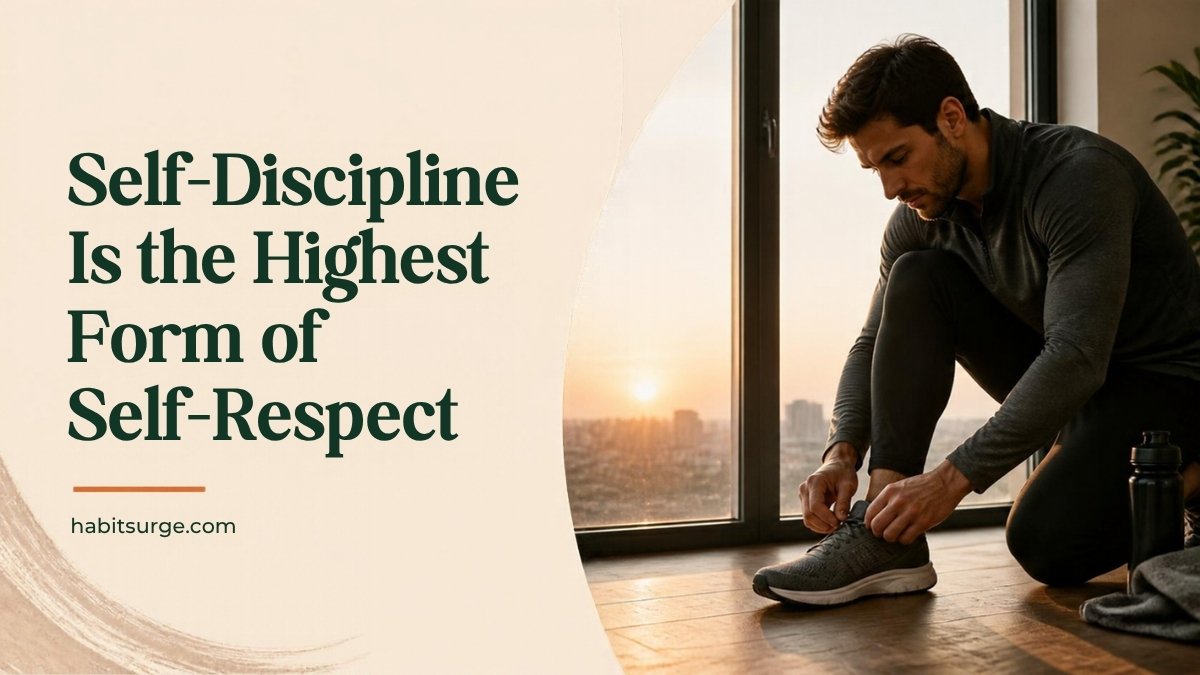
Why Self-Discipline Is the Highest Form of Self-Respect
Self-discipline is the highest form of self-respect because every promise you keep to yourself proves you can be trusted, and self-trust is what real self-respect is built on. It is not about punishment. It is about treating your future self as someone worth showing up for.
A lot of us think self-respect means feeling good about yourself: positive self-talk, affirmations in the mirror, going easy on yourself when you fall short.
I’d call that self-comfort. It has its place, but it isn’t the same thing as self-respect.
Real self-respect is built in the moments nobody sees. When you get up even though you don’t want to. When you do the work even though the feeling is gone. When you keep your word to yourself even when breaking it would be easier.
Self-discipline isn’t about restriction or punishment. It’s taking your own life seriously enough to act on it, and I think that says more about how you value yourself than any affirmation does.

Being kind to yourself matters. But self-respect, as I see it, is mostly about keeping your word to yourself when nobody’s watching.
In this guide
- The Confusion Between Comfort and Respect
- What Self-Discipline Actually Means
- Why It’s the Highest Form of Self-Respect
- The Compounding Effect of Kept Promises
- Self-Discipline vs. Self-Punishment: An Important Distinction
- How to Build Self-Discipline as an Act of Self-Respect
- The Person on the Other Side
- Why Is Self-Discipline Important?
- Why Is Self-Discipline So Hard?
- Self-Discipline vs Self-Control: What Is the Difference?
- Frequently Asked Questions
The Confusion Between Comfort and Respect
We’ve been sold a version of self-care that looks a lot like avoidance. Rest when you’re tired, don’t push too hard, be gentle with yourself.
There’s nothing wrong with rest. But there’s a difference between resting because you genuinely need recovery and avoiding because the work is hard and uncomfortable. We go deeper on this in how to do hard things.
One is wisdom. The other is fear dressed up as self-compassion.
A 2018 study in the Journal of Personality by researchers at the University of Toronto found that people with higher trait self-control reported greater life satisfaction, better relationships, and fewer regrets than those who prioritized immediate comfort. They weren’t happier because life was easier. They were happier because they trusted themselves.
That trust is what self-discipline builds. And without it, self-respect is just a feeling that comes and goes depending on your mood.
What Self-Discipline Actually Means
Self-discipline gets misunderstood because people associate it with rigidity. The person who never has fun. The one who follows a spreadsheet instead of a life.
That’s not it.
Self-discipline is the ability to act in alignment with what you actually value, rather than what you happen to feel like in the moment. It’s the gap between your intentions and your actions, closed.
Psychologist Roy Baumeister at Florida State University spent decades studying self-control. His research, summarized in Willpower: Rediscovering the Greatest Human Strength (2011), found that self-regulation failure is at the core of most personal problems, from financial struggles to broken relationships to poor health outcomes. The people who struggled most weren’t those who wanted the wrong things. They were those who couldn’t consistently act on what they wanted.
Self-discipline is the bridge between the person you are and the person you want to be. It’s a tool, not a punishment.
Why It’s the Highest Form of Self-Respect
Think about how you treat someone you deeply respect.
You show up when you say you will. You take their goals seriously. You don’t waste their time. You tell them hard truths when they need to hear them. You invest in their growth even when it’s inconvenient.
Now think about how we often treat ourselves.
They skip the workout they committed to. They put off the work until tomorrow. They break promises to themselves that they would never break to someone else. They accept mediocrity from themselves that they wouldn’t accept from anyone they cared about.
Self-discipline is simply applying to yourself the same standards you’d apply to someone you actually respect. No more, no less.
When you keep a commitment to yourself, you’re telling yourself that you, your goals and your time matter. That message, repeated daily through action rather than words, is the foundation of genuine self-respect.
The Compounding Effect of Kept Promises
Every time you follow through on something you committed to, you deposit a unit of trust into your relationship with yourself. Every time you don’t, you make a withdrawal.
It’s easy to end up running on empty. After enough broken promises to yourself (skipped workouts, abandoned projects) you stop trusting your own word, so you stop making commitments, and it gets hard to feel any sense of direction.
The reverse is also true. Research from Stanford psychologist Albert Bandura on self-efficacy, published across decades of work including his 1997 book Self-Efficacy: The Exercise of Control, consistently found that small wins compound. Each completed action strengthens the belief that future actions are possible. The discipline you build on Tuesday makes Wednesday easier.
This is not motivational language. It’s how the brain’s reward system actually works. Completing a behavior reinforces the neural pathway associated with that behavior. Over time, self-discipline stops requiring effort and becomes identity.
Self-Discipline vs. Self-Punishment: An Important Distinction
There’s a version of discipline that comes from self-hatred. The person who trains until they collapse because they hate their body. The one who works 80-hour weeks because they’re terrified of being seen as lazy. The one who restricts food because they can’t stand what they see in the mirror.
That’s not self-discipline. That’s self-punishment with discipline as the vehicle.
The difference is the source. Self-discipline rooted in self-respect asks: what does the person I want to become do today? Self-punishment rooted in self-loathing asks: what do I need to do to feel less disgusted with myself?
The first builds you up; the second wears you down.
You can tell which one you’re operating from by how you feel after a hard day of doing the work. Genuine self-discipline leaves you tired but satisfied. Self-punishment leaves you exhausted and still not good enough.
The goal is always the former. Push hard because you believe in where you’re going, not because you’re running from where you’ve been.
How to Build Self-Discipline as an Act of Self-Respect
None of this is complicated, but it does take honesty.
Start with one commitment. Not a list of fifteen habits. One thing you will do every day, non-negotiable. Make it small enough that skipping it would feel embarrassing. Get up and do it.
Keep your word to yourself first. It’s common to be reliable for everyone except yourself, so start there. If you say you’ll write for 20 minutes before checking your phone, do it. The rest can wait ten minutes.
Treat failure as data, not identity. You will miss days. The question is whether you treat a missed day as a reason to quit or a signal to adjust. Self-discipline rooted in self-respect treats failure practically: what happened, what can I change, what’s the next action.
Raise the standard gradually. Self-respect grows as your evidence grows. Keep that first commitment for 30 days. Then add a second. Each kept promise adds to your trust in yourself, and that trust is what self-respect is built on.
The Person on the Other Side
There’s a version of you that wakes up without hitting snooze. That finishes what they start. That doesn’t need external validation to feel solid, because they know who they are and they show up for themselves daily.
That person isn’t more talented than you. They’re not more motivated. They just decided at some point that they were worth showing up for. And then they proved it, one kept commitment at a time.
Self-discipline is the path from here to there. Not through restriction or punishment or rigid schedules. Through the simple, repeated act of treating yourself like someone whose time and goals and words actually matter.
Because they do.
So start today: pick one small thing and keep your word on it.
Want a system to make this easier? Download the free 7-Day Discipline Reset Guide and get a day-by-day plan for building self-discipline from scratch.
Why Is Self-Discipline Important?
Self-discipline is important because it is the bridge between what you want and what you actually do. Without it, goals stay wishes. With it, small actions stack up into real change.
- It builds self-trust. Every kept promise to yourself is proof you can rely on yourself.
- It compounds. Small daily actions add up to large results over months and years.
- It lowers stress. When the important things are handled by routine, you stop carrying them in your head.
- It frees you from mood. You act on decisions, not on how you feel in the moment.
If you want the practical side, start with our guide on how to build discipline without motivation. Once you have started, our guide on how to stay disciplined covers what to do when the excitement fades.
Why Is Self-Discipline So Hard?
Self-discipline feels hard because your brain is wired to favor immediate rewards over future ones. Scrolling pays off now. Exercise pays off in months. It’s also common to try to change too much at once, rely on willpower when they are already tired, and quit after one missed day.
The fix is not more willpower. It is better design: smaller habits, fixed triggers, and an environment that makes the right choice the easy one. Here is how to be consistent even when you don’t feel like it.
Self-Discipline vs Self-Control: What Is the Difference?
Self-control is resisting a temptation in the moment, like skipping the second slice of cake. Self-discipline is the longer pattern of choosing what you said you would do, day after day. Self-control is a single decision. Self-discipline is a system of decisions you have already made.
The good news: the more structure you build, the less self-control you need. Starting with small habits that actually stick is the easiest way in.
Go deeper: Read the complete guide on how to build habits that stick, and learn how to stay disciplined when the excitement wears off.
More practical guides: habit stacking with 40 examples, 100 habits to track, and how to get back on track after you fall off.
Frequently Asked Questions
Is self-discipline the same as willpower?
Not exactly. Willpower is a short-term resource that depletes with use, as shown in Roy Baumeister’s ego depletion research. Self-discipline is a long-term skill built through repeated behavior and identity formation. Willpower helps you get started. Self-discipline means you don’t need as much willpower over time because the behavior becomes automatic.
Can self-discipline be learned or is it a personality trait?
It can absolutely be learned. Research in behavioral psychology consistently shows that self-regulation is a skill developed through practice, environment design, and habit formation. People are not born disciplined. They build it through repeated choices made over time.
How does self-discipline improve self-respect?
Every kept commitment to yourself is evidence that you take your own goals seriously. Over time this builds self-trust, which is the foundation of genuine self-respect. You don’t need to be perfect, just reliable to yourself. People who follow through on what they say they’ll do feel better about themselves because their actions match their values.
What’s the difference between self-discipline and being too hard on yourself?
The difference is the motivation behind the behavior. Self-discipline driven by self-respect asks what the person you want to become would do. Self-punishment driven by self-loathing asks what you need to do to feel less worthless. The first is working toward something and tends to last; the second is running from something and usually breaks down.