10 Tiny Daily Habits That Secretly Transform Your Life in 90 Days
Good daily habits are small actions you repeat every day that compound over time: drinking water, moving your body, getting daylight, reading, planning tomorrow, and reviewing your day. You do not need all ten at once. Pick one, make it tiny, and build from there.
If you want more than ten to choose from, here are 50 healthy habits to start today, grouped by area of life.
Nobody wakes up one day and finds themselves completely different. Change doesn’t happen in a single dramatic moment, no matter how much we want it to.
It happens in small decisions that feel almost too minor to count: getting up when the alarm goes off, drinking water before coffee, closing the laptop at a reasonable hour, moving your body when you really don’t want to.
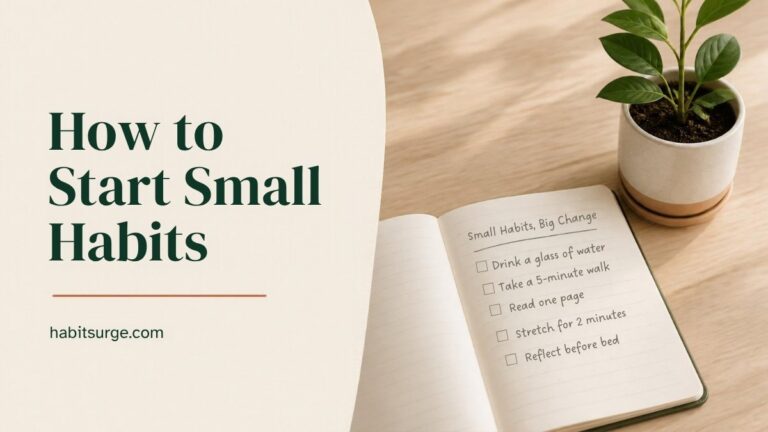
These daily habits feel insignificant in isolation. Over 90 days, they don’t just add up. They compound. And the person who stuck with them looks back and can barely recognize the person who started. If you are not sure how small to go, here is how to start small habits that actually stick.
Here are 10 daily habits that work quietly but produce changes you’ll absolutely notice.

Nobody notices these habits in the moment. But 90 days later the person doing them looks completely different. Not in a dramatic way; they just seem steadier and more in control.
In this guide
- 1. Make Your Bed Every Morning
- 2. Drink Water Before Anything Else
- 3. Move Your Body for 20 Minutes
- 4. Read for 20 Minutes Before Bed
- 5. Write Down Three Things You Need to Do Tomorrow
- 6. Spend Five Minutes Outside in Natural Light
- 7. Practice One Minute of Intentional Breathing
- 8. Eat One Meal With No Screens
- 9. Do One Thing You’ve Been Avoiding
- 10. Review Your Day for Two Minutes Before Sleep
- The 90-Day Reality
- What Are Good Daily Habits to Have?
- Good Daily Habits for Success
- Good Daily Habits for Mental Health
- Frequently Asked Questions
1. Make Your Bed Every Morning
A made bed won’t change your life on its own, but it changes how your day starts.
You finish one task before you’ve even looked at your phone. It’s a small win, but small wins are good at building momentum.
Admiral William McRaven popularized this idea in his 2014 University of Texas commencement address, later expanded into Make Your Bed (2017). His argument is practical: if you want to change the world, start by making your bed. One task completed creates the psychological readiness to complete another.
The habit takes 90 seconds. The effect lasts all day.
2. Drink Water Before Anything Else
Drink about 16 ounces (half a liter) of water when you get up, before coffee, your phone or breakfast.
After 7 to 9 hours of sleep, your body is mildly dehydrated. Research published in the Journal of Nutrition (2012) by researchers at the University of Connecticut found that even mild dehydration, as little as 1.5% loss in body water, impairs mood, concentration, and cognitive performance. You’re not starting your day foggy because you need coffee. You’re foggy because you’re slightly dehydrated.
Water first, then coffee.
3. Move Your Body for 20 Minutes
This doesn’t need to be a workout, just twenty minutes of deliberate movement. A walk, a yoga flow, a quick strength circuit. Whatever gets you away from sitting and puts your body through its range of motion.
A 2019 meta-analysis published in Preventive Medicine covering over 33,000 participants found that as little as 20 minutes of moderate daily movement significantly reduced symptoms of depression and anxiety compared to sedentary control groups. The mental health benefits alone justify this habit. The physical benefits are a bonus.
You don’t need a gym membership. You need 20 minutes and enough space to move.
4. Read for 20 Minutes Before Bed
Read a book rather than your phone. Paper or e-reader doesn’t matter much; what you read matters a lot more.
Reading before sleep does two things. It gives your nervous system a signal that the productive day is winding down. And it deposits information into your long-term memory during the consolidation window that happens in the first sleep cycles after reading.
A 2009 study from the University of Sussex found that reading for just six minutes reduced stress levels by 68%, more than listening to music or taking a walk. The immersion of reading pulls attention away from the day’s worries and settles the nervous system.
Twenty pages a night is roughly seven to ten books per year. That’s a different kind of mind after a decade.
5. Write Down Three Things You Need to Do Tomorrow
Not a full task list. Three things. The three most important actions that would make tomorrow genuinely productive rather than just busy.
This habit works for two reasons. First, it transfers your mental load off your working memory and onto paper, which is why so many people report sleeping better when they write things down before bed. A 2018 study in the Journal of Experimental Psychology by Michael Scullin at Baylor University found that writing a detailed to-do list before sleep significantly reduced the time it took participants to fall asleep.
Second, you start tomorrow knowing exactly what matters. You don’t spend the first hour of the morning working out what to do.
6. Spend Five Minutes Outside in Natural Light
Early morning light exposure is one of the most underrated habits for sleep quality, mood, and energy. Your circadian rhythm, the internal clock that regulates sleep, hormones, and dozens of other biological processes, is synchronized by light. Specifically, by natural light hitting your eyes in the first hour of waking.
Neuroscientist Andrew Huberman at Stanford University has published extensively on the relationship between morning light exposure and cortisol regulation. He notes that morning light triggers a healthy cortisol spike that provides energy and alertness throughout the day, and sets the timer for melatonin release in the evening.
Five minutes outside within an hour of waking. No sunglasses needed. Just light and open sky.
7. Practice One Minute of Intentional Breathing
It doesn’t have to be meditation. Just one minute of slow, deliberate breathing before a transition in your day. Before a difficult meeting. After getting home from work. Before sleep.
Your autonomic nervous system has two modes: sympathetic (stress response) and parasympathetic (rest and recovery). Slow, controlled breathing, specifically exhales longer than inhales, directly activates the parasympathetic system. It’s one of the few voluntary actions that can override an automatic stress response.
Research from Stanford published in Cell Reports Medicine (2023) found that a single daily five-minute session of cyclic sighing, a specific breathing pattern with a long exhale, produced measurable improvements in mood and reductions in anxiety over a four-week period.
One minute a day adds up.
8. Eat One Meal With No Screens
Pick one meal per day and eat it without a phone, laptop, or TV. Just food and whatever is in front of you.
It sounds minor, but eating while distracted is linked to eating more and feeling less satisfied afterwards, according to research in the American Journal of Clinical Nutrition (2011). It’s also an easy daily chance to slow down.
It’s also just a more human way to eat. The food tastes better when you’re actually paying attention.
9. Do One Thing You’ve Been Avoiding
Every day, there’s at least one task on your mental list that you keep pushing. The email you haven’t sent. The appointment you haven’t made. The conversation you’ve been sidestepping.
Do one of those things. Daily.
Procrastination is not a time management problem. It’s an emotion management problem. We avoid things because they produce discomfort: anxiety, uncertainty, the fear of doing them wrong. That discomfort doesn’t go away when you avoid the task. It compounds. The task gets heavier every day you don’t touch it.
Doing one avoided thing daily builds what researchers call distress tolerance. The psychological capacity to sit with discomfort long enough to act anyway. This capacity transfers everywhere. People who practice it consistently report feeling lighter, less anxious, and more in control of their lives than those who don’t.
10. Review Your Day for Two Minutes Before Sleep
This isn’t a full journal entry, just two minutes. Ask yourself two questions: What went well today? What would I do differently?
Without a moment to reflect, it’s easy to repeat the same small mistakes, not because you’re careless but because you never stopped to notice them.
Two minutes of reflection each night means 730 minutes of reflection per year. That’s over 12 hours of deliberate learning from your own life, compounded into genuine growth in how you make decisions, manage your energy, and treat the people around you.
Small investment. Enormous return over 90 days.
The 90-Day Reality
This is roughly what to expect when you stack these habits.
Week one is uncomfortable. Everything feels effortful because it is. You’re building new patterns on top of old ones and the old ones have years of momentum behind them.
By week three, a few of the habits start to feel automatic. You make your bed without thinking about it. You reach for water before coffee by default. The effort shifts to the habits that are still new.
By week six, the compounding begins to show. You sleep better. You’re less reactive. You feel more on top of things, even though your circumstances haven’t changed. What’s changed is your relationship to your own day.
By day 90, you’re a slightly different person. Not dramatically, but you’ll be more deliberate and more consistent, and more in charge of your time and attention.
That’s what these habits build. Not a perfect life. Just a life that’s more yours than it was before.
Pick two or three from this list. Start tomorrow. Don’t try to do all ten at once. Add one every week until they’re all running. Then look back at who you were in January.
Want a day-by-day plan to build these habits from scratch? Download the free 7-Day Discipline Reset Guide and start with a simple, structured system.
Go deeper: Read the complete guide on how to build habits that stick, and learn how to stay disciplined when the excitement wears off.
What Are Good Daily Habits to Have?
The best daily habits support your sleep, energy, focus and mood. A simple starter set: drink water when you wake up, move for 20 minutes, get 5 minutes of daylight, eat one meal without screens, read for 10 minutes, and plan tomorrow in 2 minutes.
Good Daily Habits for Success
- Plan your top 3 tasks the night before
- Do your hardest task first
- Protect one 25-minute focus block, phone in another room
- Learn something for 15 minutes
- Review your day for 2 minutes
Good Daily Habits for Mental Health
- Get morning daylight
- Move your body, even briefly
- Write down three things you are grateful for
- Limit social media to set times
- Connect with one person each day
These are general wellness habits, not a substitute for professional care. If you are struggling, please talk to a doctor or licensed professional.
Want to track your progress? Use our list of 100 habits to track, link new habits to old ones with habit stacking, and learn how to be consistent on hard days.
Build your mornings: use this simple morning routine checklist for adults.
Want a simple way to put this into practice? Try the 30-day self-improvement challenge: one small task a day for a month, with a free printable checklist.
Frequently Asked Questions
How long does it take for daily habits to become automatic?
Research from Phillippa Lally at University College London, published in the European Journal of Social Psychology (2010), found that habits take an average of 66 days to become automatic, with a range of 18 to 254 days depending on the complexity of the behavior and individual differences. Simple habits like drinking water first thing take far less time than complex ones like a structured workout routine.
Should I try to build all 10 habits at once?
No. Research on habit formation consistently shows that adding too many new behaviors simultaneously overwhelms the cognitive resources needed to establish any of them. Start with two or three that feel most manageable. Once those are running on autopilot, add one more. The goal is habits that stick, not habits that last two weeks and collapse.
What if I miss a day?
Miss one, not two. Research on habit disruption shows that a single missed day has minimal impact on long-term habit formation, but consecutive missed days significantly increase the likelihood of abandoning a behavior entirely. Build the rule into your system before you need it: if I miss today, I do it tomorrow no matter what.
Are morning habits more effective than evening habits?
Not inherently. The most effective habits are the ones that fit your actual life and that you can execute consistently. Morning habits have an advantage for some people because willpower and decision-making capacity tends to be higher earlier in the day before it’s been depleted by choices and stressors. But a consistent evening habit beats an inconsistent morning habit every time.