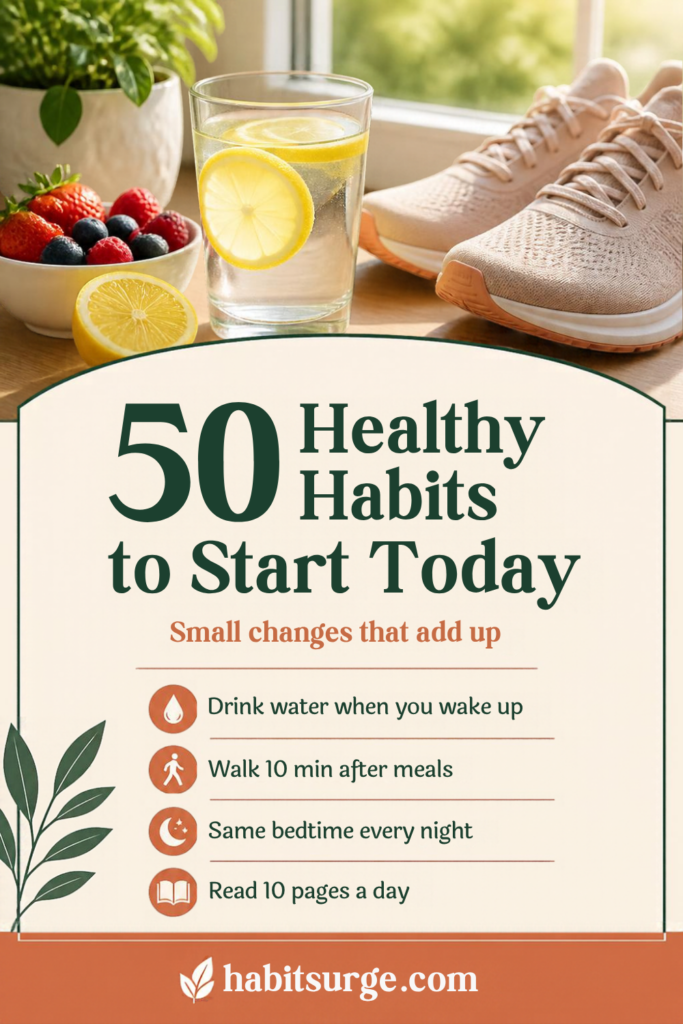
50 Healthy Habits to Start Today (Small Changes That Add Up)
The best healthy habits to start are small, specific actions you can repeat daily without much effort: drink water when you wake up, walk for 10 minutes after a meal, add a vegetable to one meal, go to bed at the same time and put your phone away an hour before sleep. Big transformations are built from boring little habits done consistently. One diary study found that roughly 43% of what people do each day is repeated almost daily in the same context, usually while thinking about something else. Change those small defaults and you change a large part of your life.
Below are 50 healthy habits to start, grouped by area of life. You do not need all 50. In fact, trying to start more than two or three at once is one of the fastest ways to start none. Read the list, pick a few that feel easy and useful, and use the tips at the end to make them stick.
In this guide
- How to Use This List
- Healthy Habits for Your Body
- Healthy Habits for Better Sleep
- Healthy Habits for Your Mind
- Healthy Habits for Productivity
- Healthy Habits for Your Money
- Healthy Habits for Your Relationships
- Healthy Habits for Your Home and Environment
- Easy Healthy Habits for Beginners
- How to Make Healthy Habits Stick
- Frequently Asked Questions
How to Use This List
- Pick one to three habits. Choose ones that feel almost too easy.
- Make each one specific. “Exercise more” is vague. “Walk 10 minutes after lunch” is a habit.
- Attach it to something you already do. Use the habit stacking formula: “After I [current habit], I will [new habit].”
- Add more later. Once a habit feels automatic, choose the next one.
Healthy Habits for Your Body
- Drink a glass of water as soon as you wake up.
- Walk for 10 minutes after one meal each day.
- Take the stairs when it is only a few floors.
- Stretch for five minutes every morning or evening.
- Stand up and move for a minute every hour you sit.
- Add one serving of vegetables to a meal you already eat.
- Keep a bowl of fruit where you can see it.
- Eat breakfast or lunch away from your screen.
- Do a short bodyweight workout three times a week.
- Aim to build up toward 150 minutes of moderate activity a week, the amount recommended for adults by U.S. health guidelines.
Healthy Habits for Better Sleep
- Go to bed and wake up at roughly the same time every day.
- Aim for at least 7 hours of sleep a night.
- Dim the lights about an hour before bed.
- Charge your phone outside the bedroom.
- Avoid caffeine in the afternoon and evening.
- Keep your bedroom cool, dark and quiet.
- Follow a simple night routine so your body knows it is time to wind down.
- Get some daylight within an hour of waking up.
Healthy Habits for Your Mind
- Write three things you are grateful for each day.
- Read 10 pages of a book daily.
- Spend five minutes in quiet breathing or meditation.
- Keep a “brain dump” notebook for worries and to-dos.
- Take a phone-free walk without headphones.
- Limit news and social media to set times.
- Learn something new for 15 minutes a day.
- Talk to yourself like you would talk to a friend.
- Spend time outdoors in nature every week.
Healthy Habits for Productivity
- Write your top 3 tasks for tomorrow before bed.
- Do your most important task before checking email.
- Work in focused 25-minute blocks with short breaks.
- Keep your phone in another room during deep work.
- Shrink tasks you are avoiding to a 2-minute first step. More in how to stop procrastinating.
- Do a weekly reset to plan your week and tidy your space. Try this Sunday reset checklist.
- Tidy your desk for two minutes at the end of every workday.
Healthy Habits for Your Money
- Check your bank balance once a week.
- Automatically move a small amount into savings every payday.
- Wait 24 hours before buying anything non-essential.
- Track your spending for one month to see where it goes.
- Unsubscribe from shopping emails you do not need.
- Cook at home one more night a week.
Healthy Habits for Your Relationships
- Send one message a day to someone you care about.
- Put your phone away during meals with others.
- Say thank you specifically, not just “thanks.”
- Schedule regular time with close friends or family.
- Listen without planning your reply.
Healthy Habits for Your Home and Environment
- Make your bed every morning.
- Do a 10-minute tidy every evening.
- Keep healthy snacks visible and treats out of sight.
- Lay out tomorrow’s clothes the night before.
- Declutter one small space each week.
Easy Healthy Habits for Beginners
If you are not sure where to start, these five are simple, quick and useful for almost everyone:
- Drink a glass of water when you wake up
- Walk for 10 minutes after one meal
- Go to bed at the same time each night
- Write tomorrow’s top 3 tasks before bed
- Make your bed in the morning
Each one takes less than 10 minutes, and together they cover your body, sleep, focus and environment. Several of them fit neatly into a short morning routine checklist.
How to Make Healthy Habits Stick
Knowing which habits to start is the easy part. Keeping them is where most people struggle. These principles make a real difference.
Start ridiculously small
A habit that takes two minutes is hard to skip. Once it is automatic, you can grow it. This is the core idea in how to start small habits that actually stick.
Use specific “when and where” plans
Decide exactly when and where you will do the habit. Research on these if-then plans, called implementation intentions, shows they significantly improve follow-through compared with general intentions.
Change your environment
Make healthy choices the easy choices. Put the water bottle on your desk, the running shoes by the door and the phone charger outside the bedroom. Your surroundings shape behavior more than willpower does.
Track it
Mark each day you complete your habit on a calendar or a habit tracker. Monitoring progress has been shown to increase the chances of reaching a goal.
Be patient
Habits take time. In one well-known study, it took participants an average of 66 days for a new daily habit to feel automatic, with big differences between people and habits. Missing a day here and there did not stop the habit from forming. If you would rather start with a short list, try these 10 tiny daily habits.
Never miss twice
You will miss days. That is normal. The rule that keeps habits alive is simple: never miss two days in a row. If you fall off completely, use the 7-step plan in how to get back on track.
Frequently Asked Questions
What are 5 healthy habits to start?
Five great healthy habits to start are drinking water when you wake up, walking 10 minutes after a meal, keeping a consistent bedtime, writing tomorrow’s top 3 tasks before bed and putting your phone away an hour before sleep.
How many habits should I start at once?
Start with one to three. Adding too many new habits at once makes it much harder to stick with any of them. Add new ones only after the first feel automatic.
How long does it take to build a healthy habit?
It varies a lot by person and habit. Research suggests an average of around two months for a daily behavior to become automatic, but some simple habits form faster and complex ones take longer.
What is the easiest healthy habit to start?
Drinking a glass of water right after waking up is one of the easiest. It takes seconds, needs no equipment and can be attached to an existing habit like turning off your alarm.
How do I stay consistent with healthy habits?
Keep habits small, attach them to existing routines, set up your environment to make them easy, track your progress and follow the “never miss twice” rule.
References
- Lally, P., van Jaarsveld, C. H. M., Potts, H. W. W., & Wardle, J. (2010). How are habits formed: Modelling habit formation in the real world. European Journal of Social Psychology, 40(6), 998–1009.
- Gollwitzer, P. M., & Sheeran, P. (2006). Implementation intentions and goal achievement: A meta-analysis of effects and processes. Advances in Experimental Social Psychology, 38, 69–119.
- Harkin, B., Webb, T. L., Chang, B. P. I., et al. (2016). Does monitoring goal progress promote goal attainment? A meta-analysis of the experimental evidence. Psychological Bulletin, 142(2), 198–229.
- Wood, W., Quinn, J. M., & Kashy, D. A. (2002). Habits in everyday life: Thought, emotion, and action. Journal of Personality and Social Psychology, 83(6), 1281–1297.
- U.S. Department of Health and Human Services. (2018). Physical Activity Guidelines for Americans, 2nd edition.
- Centers for Disease Control and Prevention. About Sleep: How much sleep do I need? (Adults 18–60 need 7 or more hours per night.)