
Night Routine Checklist for Adults: A Simple Evening Routine for Better Sleep
A good night routine is a short, repeatable sequence that tells your body and brain the day is over: close out work, reset your space, dim the lights, step away from screens and do one calming thing before bed. It does not need to be long or aesthetic. It needs to be the same most nights.
Most people try to fix their mornings first. But a rushed, chaotic morning usually starts the night before: a late scroll, a messy kitchen, no plan for tomorrow and a brain that is still running at 11:30 p.m. Fix the evening and the morning gets easier on its own.
If your evenings tend to disappear into your phone, our guide on how to stop doom scrolling pairs well with this routine.
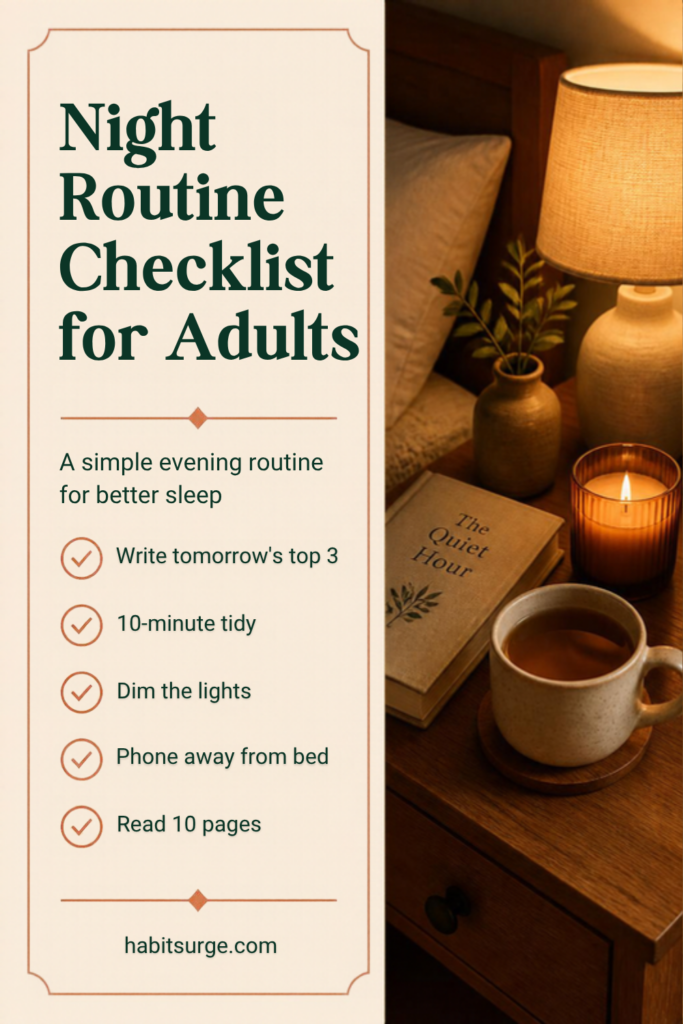
Below is a simple night routine checklist for adults, the reasoning behind each step, and 15, 30 and 60-minute versions you can start with tonight.
In this guide
Why a Night Routine Matters
Your body runs on a roughly 24-hour clock that responds strongly to light, timing and repetition. When you do the same few things in the same order every evening, those actions become cues that sleep is coming. Over time the routine itself starts to make you sleepy.
A consistent evening routine also helps in three practical ways:
- It closes open loops. Unfinished tasks keep your mind busy. Writing them down gives your brain permission to stop rehearsing them.
- It protects your sleep window. Most adults need at least 7 hours of sleep. A routine that starts at a set time makes it much harder for “one more episode” to eat that time.
- It makes tomorrow easier. Five minutes of reset at night saves you twenty minutes of friction in the morning.
If you already have a morning routine checklist, think of the night routine as its other half. One ends the day cleanly; the other starts it on purpose.
The Night Routine Checklist
Here is the full checklist. You do not need every item. Pick the ones that solve your biggest evening problem and build from there.
1. Set a “shutdown time” for work
Pick a time when work is officially over, even if you work from home. Close the laptop, close the tabs and stop checking messages. A clear end point stops work from leaking into the whole evening.
2. Write tomorrow’s top 3 tasks
Take two minutes to write the three most important things you need to do tomorrow. In a sleep lab study, people who spent five minutes writing a specific to-do list before bed fell asleep faster than people who wrote about tasks they had already finished. Getting tasks out of your head and onto paper seems to quiet the mental rehearsal.
3. Do a 10-minute reset of your space
Clear the kitchen counter, load the dishwasher, put away what is out of place in the room you wake up in. You are not deep cleaning. You are making sure the first thing you see tomorrow is calm, not chaos.
4. Prepare one thing for the morning
Lay out clothes, pack your bag, fill your water bottle or set up the coffee maker. One small prep step removes one decision from your morning.
5. Dim the lights about an hour before bed
Bright light in the evening tells your brain it is still daytime. Switch to lamps or warmer, dimmer lighting about an hour before you plan to sleep. It is one of the easiest signals you can send.
6. Put your phone away from your bed
Research comparing reading on a light-emitting tablet with reading a printed book found that the screen readers took longer to fall asleep and felt less alert the next morning. The bigger problem for most people is not the light but the endless scroll. Charge your phone outside the bedroom, or at least across the room, and use a cheap alarm clock if you need one.
7. Take care of your body
Brush your teeth, wash your face and do whatever basic care makes you feel clean and done for the day. Keep it simple. The point is the signal, not a 12-step routine.
8. Do one calming activity
Read a few pages of a paper book, stretch for five minutes, take a warm shower, listen to quiet music or do a short breathing exercise. Choose one and keep it consistent.
9. Reflect for one minute
Write one line in a journal: one thing that went well today, or one thing you are grateful for. This ends the day on something finished instead of something worrying.
10. Go to bed at roughly the same time
A consistent bedtime is the anchor that holds the routine together. Aim for the same time within about 30 minutes, including most weekends.
A Simple Night Routine Schedule
Here is how the checklist fits into a real evening if you want to be asleep by 10:30 p.m.:
- 7:00 p.m. Work shutdown and write tomorrow’s top 3 tasks
- 8:30 p.m. 10-minute reset of the kitchen and living space
- 9:15 p.m. Prepare one thing for the morning, then dim the lights
- 9:30 p.m. Phone goes on the charger outside the bedroom
- 9:45 p.m. Shower, teeth, skincare
- 10:00 p.m. Read or stretch, then one line of reflection
- 10:30 p.m. Lights out
Shift every time to match your own bedtime. What matters is the order and the consistency, not the exact clock.
15, 30 and 60-Minute Night Routines
Not every night looks the same. Having a short version means you never have to skip the routine entirely, which is how most routines quietly die. If you want the deeper reasoning, read how to be consistent even when you do not feel like it.
The 15-minute night routine
- Write tomorrow’s top 3 tasks (2 minutes)
- Quick reset of one room (5 minutes)
- Phone away from bed (1 minute)
- Teeth, face, lights down (5 minutes)
- One line of reflection (2 minutes)
The 30-minute night routine
- Work shutdown and top 3 tasks (5 minutes)
- 10-minute space reset
- Prepare clothes or bag for tomorrow (3 minutes)
- Phone away, lights dimmed (2 minutes)
- Body care (5 minutes)
- Read a paper book (5 minutes)
The 60-minute night routine
- Work shutdown and top 3 tasks (5 minutes)
- 15-minute space reset
- Morning prep (5 minutes)
- Warm shower and body care (15 minutes)
- Stretching or breathing (10 minutes)
- Read and reflect (10 minutes)
Night Routine Ideas by Goal
For better sleep
Keep the bedroom cool, dark and quiet. Avoid heavy meals and caffeine late in the day. Keep the last 30 minutes before bed screen-free and boring in the best way.
For productivity
Your evening is where tomorrow’s productivity is decided. The top-3 list and a clean desk do more for your morning focus than any app. Pair this with a simple habit stacking chain: “After I close my laptop, I will write tomorrow’s top 3 tasks.”
For self-care
Choose one thing that feels genuinely restorative: a bath, a face mask, a phone call with a friend, a few pages of a novel. Self-care at night works best when it is something you look forward to rather than another task. For more ideas, our self-care routine checklist has 60 of them, split into daily, weekly and monthly.
For a calmer mind
Try a “brain dump”: write down everything on your mind for five minutes, without organizing it. Then circle anything that truly needs action tomorrow and let the rest go.
How to Make Your Night Routine Stick
A night routine is a habit like any other, and the same rules apply. Most people fail because they start with a perfect 90-minute routine and drop it after three days.
- Start with one or two steps. A phone-away rule and a top-3 list are enough for week one. See how to start small habits that actually stick.
- Anchor it to something you already do. “After I finish dinner, I will reset the kitchen.”
- Have a bad-day version. On a terrible night, do just the 15-minute version. Doing something keeps the chain alive.
- Never miss twice. Missing one night is normal. Missing two starts a new habit of skipping.
- Expect it to take weeks. In one well-known study, it took participants an average of 66 days for a new daily behavior to feel automatic, with a very wide range between people. Be patient.
Common Night Routine Mistakes
- Making it too long. If your routine needs 90 minutes, you will skip it on any busy evening.
- Scrolling “just to relax.” It rarely stays at five minutes. Decide where the phone sleeps before you need the willpower.
- Inconsistent bedtimes. A routine that ends at a different time every night loses most of its power.
- Using the evening to catch up on work. If work regularly runs into your night, the fix is earlier in the day, not later.
- All-or-nothing thinking. A half routine is still a routine. Do the short version and move on.
Frequently Asked Questions
What is a good night routine for adults?
A good night routine for adults includes a clear work shutdown, a short list of tomorrow’s priorities, a quick tidy of your space, dimmer lights, putting the phone away from the bed, basic body care and one calming activity before a consistent bedtime.
How long should a night routine be?
Between 15 and 60 minutes is realistic for most adults. A short routine you do every night beats a long one you only manage on easy evenings.
What time should I start my night routine?
Start about 60 to 90 minutes before your planned bedtime. If you want to sleep at 10:30 p.m., begin winding down around 9:00 to 9:30 p.m.
Should I stop using my phone before bed?
Yes, ideally for the last 30 to 60 minutes. Evening screen use is linked to taking longer to fall asleep, and scrolling tends to push bedtime later. Charging your phone outside the bedroom is the simplest fix.
How do I stick to a night routine?
Start with one or two steps, attach them to something you already do after dinner, keep a 15-minute backup version for busy nights, and never skip two nights in a row.
References
- Scullin, M. K., Krueger, M. L., Ballard, H. K., Pruett, N., & Bliwise, D. L. (2018). The effects of bedtime writing on difficulty falling asleep: A polysomnographic study comparing to-do lists and completed activity lists. Journal of Experimental Psychology: General, 147(1), 139–146.
- Chang, A. M., Aeschbach, D., Duffy, J. F., & Czeisler, C. A. (2015). Evening use of light-emitting eReaders negatively affects sleep, circadian timing, and next-morning alertness. Proceedings of the National Academy of Sciences, 112(4), 1232–1237.
- Lally, P., van Jaarsveld, C. H. M., Potts, H. W. W., & Wardle, J. (2010). How are habits formed: Modelling habit formation in the real world. European Journal of Social Psychology, 40(6), 998–1009.
- Centers for Disease Control and Prevention. About Sleep: How much sleep do I need? (Adults 18–60 need 7 or more hours per night.)