Sunday Reset Checklist: A Simple Routine to Start the Week Calm
A Sunday reset is a short weekly routine where you tidy your space, plan the week ahead, prep a few essentials and do something restorative, so Monday starts calm instead of chaotic. It is not about cleaning the whole house or scheduling every minute. It is about closing last week and setting up the next one on purpose.
The idea took off on social media, but the reason it works is simple. Most stress on a Monday comes from things that were already true on Sunday: no plan, no groceries, laundry piled up and a vague sense that you are behind. A few focused hours turn that vague dread into a clear list. The same idea works daily: a short morning routine checklist does for each day what the reset does for the week.
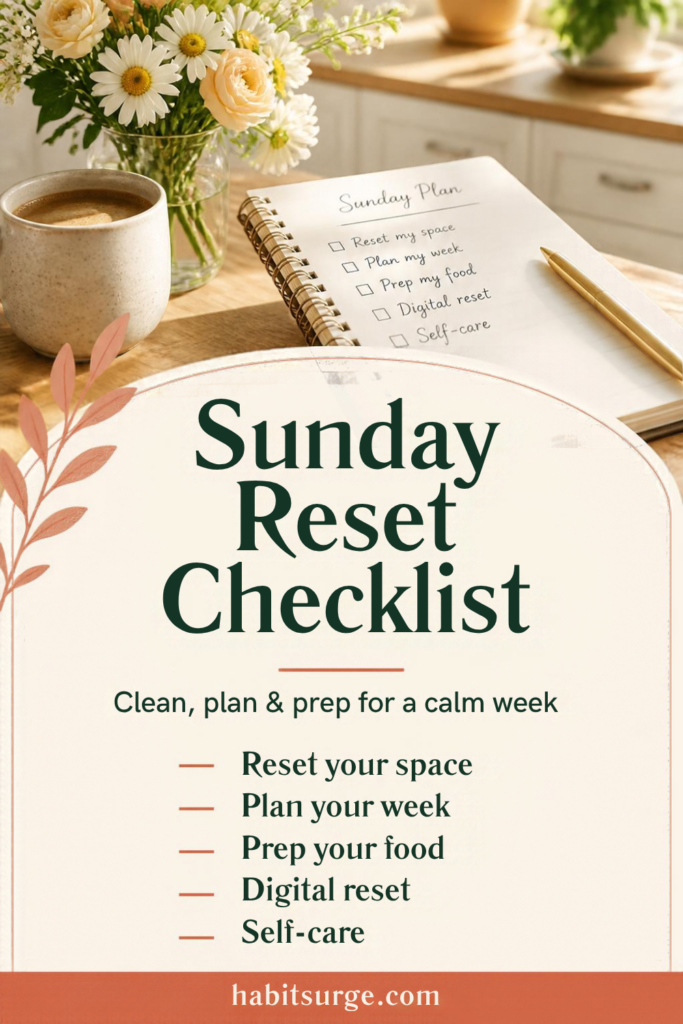
Here is a complete Sunday reset checklist, a one-hour express version, and tips to make it a habit you actually keep.
In this guide
Why a Sunday Reset Works
A weekly reset combines two things that research and common sense both support: a calmer environment and a clear plan.
- Clutter adds stress. In one study of dual-income families, people who described their homes as cluttered or unfinished showed less healthy daily cortisol patterns and more depressed mood across the day. Your space affects how you feel in it.
- Planning quiets the mind. Unfinished goals tend to keep popping into your head. Experiments on goal planning found that simply making a specific plan for an unfinished task reduced those intrusive thoughts, even before the task was done.
- One weekly checkpoint beats daily guilt. Instead of feeling behind every day, you get one dedicated time each week to catch up and reset.
The Complete Sunday Reset Checklist
Work through the five areas below. Do them in order, because each one makes the next easier.
Part 1: Reset your space (60–90 minutes)
- Clear and wipe the kitchen counters
- Empty the dishwasher and sink
- Take out the trash and recycling
- Do a 15-minute “put things back” sweep of the main living areas
- Change the bed sheets (every week or every other week)
- Start at least one load of laundry and fold it the same day
- Tidy your desk or workspace
- Clear your car of trash and bags
You are aiming for “reset,” not “spotless.” If you only have time for one thing, clear the kitchen and your desk.
Part 2: Reset your plan (20–30 minutes)
- Review last week: what got done, what slipped, what you learned
- Check your calendar for the week ahead, including appointments and deadlines
- Write your top 3 priorities for the week
- Block time on your calendar for those priorities before other things fill it
- Choose one habit to focus on this week
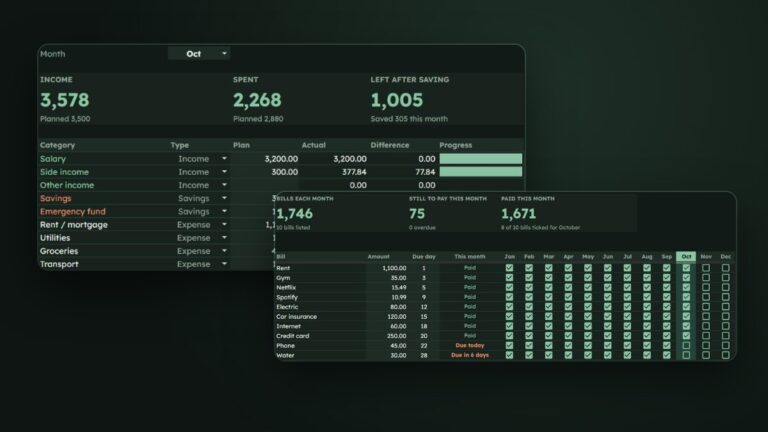
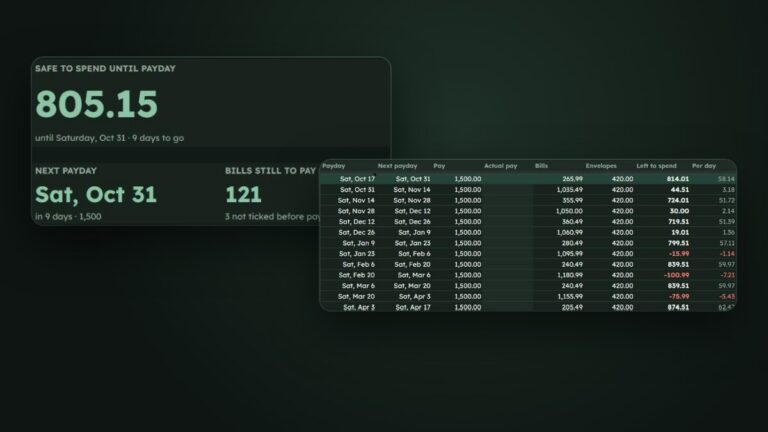
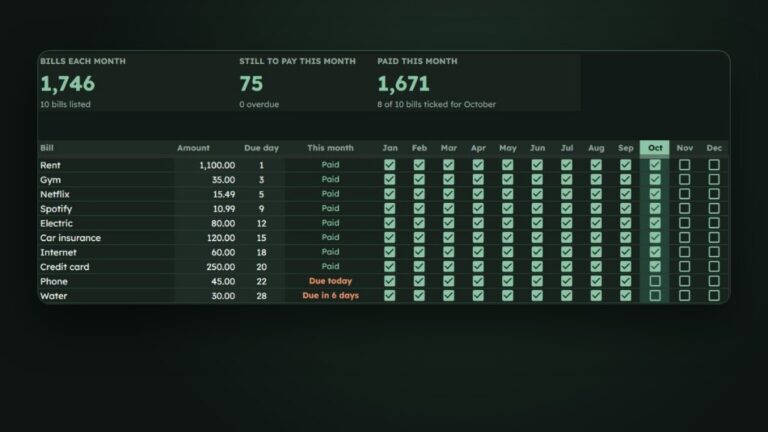
- Check upcoming bills and payments (a monthly budget template with a bill tracker makes this a two-minute job)
If you struggle to follow through on plans, pair this with a simple habit tracker so you can see your week at a glance.
Part 3: Reset your food (45–90 minutes)
- Check what is already in the fridge and pantry
- Plan dinners for at least the first three weekdays
- Write a grocery list and shop or order online
- Wash and chop vegetables and fruit for easy snacks
- Cook one or two base ingredients: a grain, a protein, a big batch of soup
- Fill water bottles and pack tomorrow’s lunch
You do not need a full meal-prep marathon. Even prepping three dinners removes most of the weeknight “what’s for dinner” stress.
Part 4: Reset your digital life (15–20 minutes)
- Clear your email inbox or at least archive what you do not need
- Delete screenshots and downloads you no longer need
- Charge your devices, earbuds and laptop
- Back up photos and important files
- Unsubscribe from a few emails you never read
Part 5: Reset yourself (30–60 minutes)
- Take a long shower or bath
- Do a simple self-care step you skip during the week: nails, hair, skincare
- Go for a walk outside
- Read, journal or do something creative
- Lay out clothes for Monday
- Go to bed on time Sunday night, using a simple night routine
The 1-Hour Express Sunday Reset
Busy weekend? Do this compressed version. It covers the highest-impact items.
- 15 minutes: Clear the kitchen, take out the trash, quick living room sweep
- 10 minutes: Start a load of laundry
- 15 minutes: Check your calendar, write your top 3 priorities and plan three dinners
- 10 minutes: Write and send your grocery order
- 10 minutes: Lay out Monday’s clothes, charge devices, fill your water bottle
One hour, and Monday already looks different.
A Sample Sunday Reset Schedule
If you have more of the day, here is one way to spread the reset out so it does not swallow your whole Sunday:
- 10:00 a.m. Space reset, laundry started
- 11:30 a.m. Plan the week with a coffee
- 12:00 p.m. Grocery shopping
- 2:00 p.m. Food prep, laundry folded
- 3:30 p.m. Free time
- 7:00 p.m. Digital reset and self-care
- 9:30 p.m. Night routine and early bedtime
Keep the afternoon free if you can. A reset should leave you rested, not exhausted.
How to Make the Sunday Reset a Habit
The reset only helps if you do it most weeks. A few principles from habit research make that far more likely:
- Same time every week. Pick a fixed block, like Sunday at 10 a.m. Specific “when and where” plans are one of the most reliable ways to follow through on intentions.
- Start small. Your first reset can be the one-hour version. Add more only when it feels easy. Read more in how to start small habits.
- Make it enjoyable. Put on a podcast, a playlist or an audiobook you only allow yourself during the reset. Pairing a chore with something you enjoy is called temptation bundling, and it has been shown to increase follow-through.
- Use a checklist. You should not have to think about what to do. Print or save the list above and tick through it.
- Do not chase perfection. If you skip a week, just do the express reset the next Sunday. See how to get back on track for a simple restart plan.
Sunday Reset Ideas for Different Lifestyles
For busy parents
Get kids involved in a 10-minute family tidy. Prep lunches and lay out school clothes for Monday and Tuesday. Check school calendars for the week.
For students
Review assignments and deadlines, organize notes and your bag, and block study sessions on your calendar before the week starts.
For people who work from home
Reset your workspace as if it were an office desk. Close the laptop and put it away for the rest of Sunday so your home feels like home again.
For anyone feeling burned out
Skip the cleaning list for one week. Do only Part 2 (plan) and Part 5 (rest). Sometimes the most useful reset is permission to recover.
Frequently Asked Questions
What is a Sunday reset?
A Sunday reset is a weekly routine, usually done on Sunday, where you tidy your home, plan the coming week, prep food and do something restorative so you start Monday feeling organized and calm.
What should be on a Sunday reset checklist?
The core items are: clear the kitchen, do laundry, take out the trash, review your calendar, set your top 3 weekly priorities, plan meals and shop, charge devices, lay out Monday’s clothes and do one self-care activity. Need ideas for that last one? Our self-care routine checklist has 60.
How long should a Sunday reset take?
An express reset takes about one hour. A full reset including meal prep usually takes three to four hours spread across the day. Start with the short version and build up.
Does a Sunday reset have to be on Sunday?
No. Any day before your week starts works. If your weekend is busy, a Saturday morning or even a Monday evening reset gives the same benefits.
How do I stay motivated to do a Sunday reset?
Keep it short, do it at the same time every week, pair it with something enjoyable like a favorite podcast, and focus on how much calmer Monday feels afterward.
References
- Saxbe, D. E., & Repetti, R. (2010). No place like home: Home tours correlate with daily patterns of mood and cortisol. Personality and Social Psychology Bulletin, 36(1), 71–81.
- Masicampo, E. J., & Baumeister, R. F. (2011). Consider it done! Plan making can eliminate the cognitive effects of unfulfilled goals. Journal of Personality and Social Psychology, 101(4), 667–683.
- Gollwitzer, P. M., & Sheeran, P. (2006). Implementation intentions and goal achievement: A meta-analysis of effects and processes. Advances in Experimental Social Psychology, 38, 69–119.
- Milkman, K. L., Minson, J. A., & Volpp, K. G. M. (2014). Holding the Hunger Games hostage at the gym: An evaluation of temptation bundling. Management Science, 60(2), 283–299.