
30-Day Self-Improvement Challenge: Your Daily Plan + Free Checklist
A 30-day self-improvement challenge gives you one small, specific task each day for a month, building from simple habits in week one to bigger changes by week four. The goal is not to transform your life in 30 days. It is to prove to yourself that you can show up every day, and to finish the month with a few habits that actually stick.
Prefer to start with just a few habits? Try these 10 tiny daily habits first.
Most self-improvement plans fail because they ask for everything at once: wake up at 5 a.m., work out daily, meditate, journal, read an hour and quit sugar, starting Monday. By Thursday it has collapsed.
This challenge works the other way. Each day adds one small action. Some days you keep doing the earlier tasks; some days are one-time actions. By the end you will have built momentum instead of burning out.
In this guide
How the Challenge Works
- One task per day. Each takes 5 to 30 minutes.
- Four themes. Week 1 builds foundations, week 2 focuses on your body, week 3 on your mind and week 4 on your future.
- Keep the “keepers.” Tasks marked as daily habits are worth continuing after their day. Do them if you can, but do not let them stop you from doing the new task.
- Track it. Tick off each day on a calendar or a simple habit tracker. Watching the chain grow is part of the motivation.
- Never miss twice. If you miss a day, do that day’s task tomorrow along with the next one. Missing once is normal; missing twice is how challenges end.
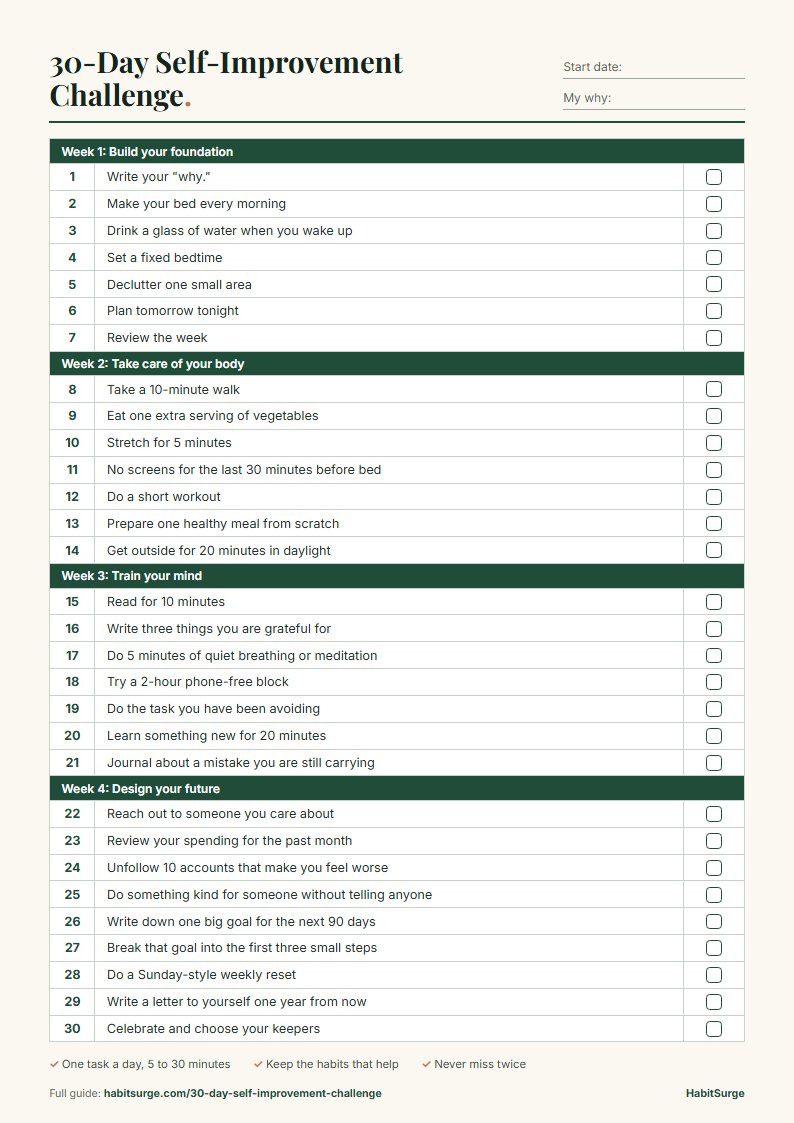
30-Day Self-Improvement Challenge Checklist
Here is the whole month at a glance. Each task is explained day by day below.
Prefer paper? Download the free printable 30-day challenge checklist (PDF). Print it, stick it on your fridge and tick off each day.
| Day | Task | Theme |
|---|---|---|
| 1 | Write your “why.” | Foundation |
| 2 | Make your bed every morning | Foundation |
| 3 | Drink a glass of water when you wake up | Foundation |
| 4 | Set a fixed bedtime | Foundation |
| 5 | Declutter one small area | Foundation |
| 6 | Plan tomorrow tonight | Foundation |
| 7 | Review the week | Foundation |
| 8 | Take a 10-minute walk | Body |
| 9 | Eat one extra serving of vegetables | Body |
| 10 | Stretch for 5 minutes | Body |
| 11 | No screens for the last 30 minutes before bed | Body |
| 12 | Do a short workout | Body |
| 13 | Prepare one healthy meal from scratch | Body |
| 14 | Get outside for 20 minutes in daylight | Body |
| 15 | Read for 10 minutes | Mind |
| 16 | Write three things you are grateful for | Mind |
| 17 | Do 5 minutes of quiet breathing or meditation | Mind |
| 18 | Try a 2-hour phone-free block | Mind |
| 19 | Do the task you have been avoiding | Mind |
| 20 | Learn something new for 20 minutes | Mind |
| 21 | Journal about a mistake you are still carrying | Mind |
| 22 | Reach out to someone you care about | Future |
| 23 | Review your spending for the past month | Future |
| 24 | Unfollow 10 accounts that make you feel worse | Future |
| 25 | Do something kind for someone without telling anyone | Future |
| 26 | Write down one big goal for the next 90 days | Future |
| 27 | Break that goal into the first three small steps | Future |
| 28 | Do a Sunday-style weekly reset | Future |
| 29 | Write a letter to yourself one year from now | Future |
| 30 | Celebrate and choose your keepers | Future |
Week 1: Build Your Foundation
The first week is about easy wins and setting up your environment for success.
- Day 1: Write your “why.” In a few sentences, write why you are doing this challenge and what you want to feel like on day 30.
- Day 2: Make your bed every morning. It takes two minutes and starts the day with something finished. (Keeper)
- Day 3: Drink a glass of water when you wake up. Attach it to something you already do, like turning off your alarm. (Keeper)
- Day 4: Set a fixed bedtime. Choose a bedtime that allows at least 7 hours of sleep and set a reminder 60 minutes before. (Keeper)
- Day 5: Declutter one small area. A drawer, your desk or your phone’s home screen.
- Day 6: Plan tomorrow tonight. Before bed, write tomorrow’s top 3 tasks. (Keeper)
- Day 7: Review the week. What felt easy? What felt hard? Adjust anything that is too big.
Week 2: Take Care of Your Body
Small physical habits have a big effect on energy and mood.
- Day 8: Take a 10-minute walk. Outside if possible. (Keeper)
- Day 9: Eat one extra serving of vegetables. Add it to a meal you already eat.
- Day 10: Stretch for 5 minutes. Morning or evening, wherever it fits best. (Keeper)
- Day 11: No screens for the last 30 minutes before bed. Read or do a simple night routine instead.
- Day 12: Do a short workout. 15 minutes of bodyweight exercise, a jog, a class or a dance session.
- Day 13: Prepare one healthy meal from scratch.
- Day 14: Get outside for 20 minutes in daylight. Morning light is especially helpful for your sleep cycle.
Week 3: Train Your Mind
This week focuses on attention, emotions and learning.
- Day 15: Read for 10 minutes. A book, not a feed. (Keeper)
- Day 16: Write three things you are grateful for.
- Day 17: Do 5 minutes of quiet breathing or meditation.
- Day 18: Try a 2-hour phone-free block. Notice how often you reach for it.
- Day 19: Do the task you have been avoiding. Use the tips in how to stop procrastinating: shrink it to a 2-minute first step and start.
- Day 20: Learn something new for 20 minutes. A skill, a language lesson, a tutorial.
- Day 21: Journal about a mistake you are still carrying. Write what you learned and let it go.
Week 4: Design Your Future
The last stretch is about relationships, money and turning the challenge into a lifestyle.
- Day 22: Reach out to someone you care about. A call, a message or a coffee.
- Day 23: Review your spending for the past month. No judgment, just awareness.
- Day 24: Unfollow 10 accounts that make you feel worse.
- Day 25: Do something kind for someone without telling anyone.
- Day 26: Write down one big goal for the next 90 days.
- Day 27: Break that goal into the first three small steps.
- Day 28: Do a Sunday-style weekly reset. Tidy, plan and prep for next week.
- Day 29: Write a letter to yourself one year from now.
- Day 30: Celebrate and choose your keepers. Pick the two or three habits from this month you want to continue.
Want to keep your keepers going all year? The HabitSurge Life Planner is a Google Sheet with 12 monthly habit trackers, streaks and goal progress that update by themselves.
Tips to Finish the Challenge
Start smaller than you think
If a task feels too big, cut it in half. Five minutes of stretching instead of twenty is still a win. The research on starting small habits is clear: tiny, consistent actions beat ambitious, inconsistent ones.
Attach new habits to old ones
Use the formula “After I [current habit], I will [new habit].” After I pour my coffee, I will write my top 3 tasks. This technique, called habit stacking, gives every new habit a built-in reminder.
Prepare for bad days
Decide now what you will do on a day when everything goes wrong. For example: “If I am exhausted, I will do the smallest possible version of today’s task.” A bad-day plan protects your streak.
Track your progress visibly
Cross off days on a paper calendar on your fridge or wall. Seeing progress is motivating, and studies show that monitoring progress toward a goal increases the chances of reaching it.
Do not expect a new person on day 30
Thirty days is a strong start, not a finish line. In a well-known study on habit formation, it took participants an average of 66 days for a daily behavior to feel automatic, with a range of 18 to 254 days depending on the person and the habit (Lally et al., 2010). Use this month to build momentum, then keep your favorite habits going.
What to Do After 30 Days
Finishing is a big deal, so take a moment to notice what changed. Then:
- Keep two or three habits. Not all of them. Pick the ones that made the biggest difference.
- Repeat the hardest week. If week 3 felt tough, run it again.
- Set your next 90-day goal. Use what you wrote on days 26 and 27.
- Restart if you fall off. You do not need a new Monday. Use the simple plan in how to get back on track.
Frequently Asked Questions
What is a 30-day self-improvement challenge?
It is a structured month where you complete one small self-improvement task each day, such as drinking water in the morning, walking for 10 minutes or reading before bed, to build momentum and lasting habits.
Can you really change in 30 days?
You can build noticeable momentum and several new habits in 30 days, but most habits take longer to become fully automatic. Treat the challenge as a strong start and keep the habits that work.
What if I miss a day?
Do the missed task the next day along with that day’s task, and follow the “never miss twice” rule. One missed day does not ruin the challenge.
Do I have to keep doing every task?
No. Some tasks are one-time actions and some are worth keeping. Continue the daily “keepers” if you can, but never let them stop you from doing the new day’s task.
Is there a printable 30-day challenge checklist?
Yes. Download the free printable checklist (PDF). It has all 30 tasks on one page with a box to tick each day.
Is 30 days enough to build a habit?
For some simple habits, yes, but most take longer. Research found habits took between 18 and 254 days to feel automatic, with an average of 66. Thirty days gets you started; keep going with the habits that matter most.
What is the best day to start?
Today. You do not need to wait for a Monday or the first of the month. Start with Day 1 and keep going.
References
- Lally, P., van Jaarsveld, C. H. M., Potts, H. W. W., & Wardle, J. (2010). How are habits formed: Modelling habit formation in the real world. European Journal of Social Psychology, 40(6), 998–1009.
- Harkin, B., Webb, T. L., Chang, B. P. I., et al. (2016). Does monitoring goal progress promote goal attainment? A meta-analysis of the experimental evidence. Psychological Bulletin, 142(2), 198–229.
- Gollwitzer, P. M., & Sheeran, P. (2006). Implementation intentions and goal achievement: A meta-analysis of effects and processes. Advances in Experimental Social Psychology, 38, 69–119.
- Centers for Disease Control and Prevention. About Sleep: How much sleep do I need? (Adults 18–60 need 7 or more hours per night.)
