How to Build Habits That Stick: The Complete Soft Discipline Guide
To build habits that stick, start with an action so small you can do it on your worst day, schedule it when your energy supports it, design your environment so the habit is the easy choice, and follow one rule when you slip: never miss twice. That is the Soft Discipline Method in one sentence. The rest of this guide shows you how to apply it.
If you have tried to build a habit and watched it fall apart, you are in good company.
Maybe it was a 5 AM workout routine that was gone by day eight, or a journaling habit that lasted eleven days, or a reading habit you were sure would stick this time and that was dead in two weeks.
That usually isn’t laziness or a lack of motivation. It’s the wrong approach.
A lot of habit advice treats discipline as something you either have or don’t: get harder on yourself, wake up earlier, want it more. The message was always the same: the reason your habits fail is because you’re not trying hard enough.
That’s wrong. And it’s quietly ruined more people’s routines than any distraction or bad day ever has.
This guide is about a different approach. We call it Soft Discipline. It isn’t about going easy on yourself. The research on habits points to design (how big the habit is, when it happens and what cues it) mattering more than intensity.
By the end of this article, you’ll have a complete system: five specific steps, backed by behavioral science, to build habits that actually last past day fourteen.
In this guide
What Is Soft Discipline? (And Why Hard Discipline Usually Fails)
Soft Discipline is a habit-building framework centered on system design over willpower. Rather than relying on motivation or mental toughness to maintain consistency, Soft Discipline uses behavioral architecture (small actions, environmental cues, and recovery protocols) to make consistency the path of least resistance.
One reason the hard approach fails is that it leans on willpower, and willpower is unreliable.
Roy Baumeister’s early research on “ego depletion” (Baumeister et al., 1998) suggested that self-control runs down like a battery over the day. Large replication attempts since then have not confirmed that effect, so treat it with caution. Still, most of us know the feeling: after a long day of decisions, meetings and stress, there isn’t much left to fight yourself with.
Hard discipline says: push through it anyway. Soft Discipline says: remove the need to push.
This isn’t a new concept wrapped in softer language. The behavioral science behind it (environmental design, implementation intentions, identity-based goals) has been documented across decades of research. The Soft Discipline Method simply packages these tools into a system you can apply today, regardless of how motivated you feel.
Why Your Habits Keep Breaking (It’s Not What You Think)
Most habit failures aren’t motivation failures. They’re design failures. The habit was set up in a way that made failure more likely than success.
A 2010 study published in the European Journal of Social Psychology by Phillippa Lally and colleagues at University College London found that habits take an average of 66 days to form, not the popular 21-day myth. Range: 18 to 254 days, depending on the behavior and the person. That means many people quit long before a habit has a chance to become automatic.
There are four specific design failures that cause most habit breaks:
1. The threshold is too high from day one. You decide to meditate for 30 minutes every morning. By day three, that commitment feels like a debt you can’t repay. The habit breaks. Not because you’re undisciplined, but because the entry point was unrealistic.
2. The environment fights the habit. Your running shoes are in the closet. Your phone is next to your bed. Your couch is in direct line of sight of the TV. Every physical cue in your environment pulls you away from the habit and toward comfort. No amount of willpower wins that fight consistently.
3. There’s no recovery protocol. You miss a day. Then comes the thought: “I’ve broken the streak, so what’s the point?” This cognitive pattern, what psychologists call the “what-the-hell effect,” turns a single missed day into a complete collapse.
4. The reward is too far away. Long-term habits like exercise or diet have delayed payoffs. Without a system that delivers small, immediate rewards, the habit feels like pure sacrifice with no return.
The good news: all four of these are fixable. That’s exactly what the Soft Discipline Method addresses.
Related: Why your habits break on day 4 (the psychology and the fix)
The 5-Step Soft Discipline Method
This is the core system. Each step addresses one of the four design failures above and builds on the one before it. You don’t need to implement all five overnight. But you do need all five eventually for the system to hold.
Step 1: Minimum Viable Action
The smallest version of your habit that still counts as doing it.
BJ Fogg, behavior scientist at Stanford and author of Tiny Habits, has coached more than 40,000 people through his method, which starts with actions so small they feel almost embarrassing (Fogg, 2019). The brain doesn’t distinguish between “I ran 5 miles” and “I put on my running shoes and stepped outside.” Both register as having done the habit.
Your Minimum Viable Action (MVA) is the floor, not the ceiling. Once you’re in motion, you almost always do more. But you only commit to the floor.
Examples:
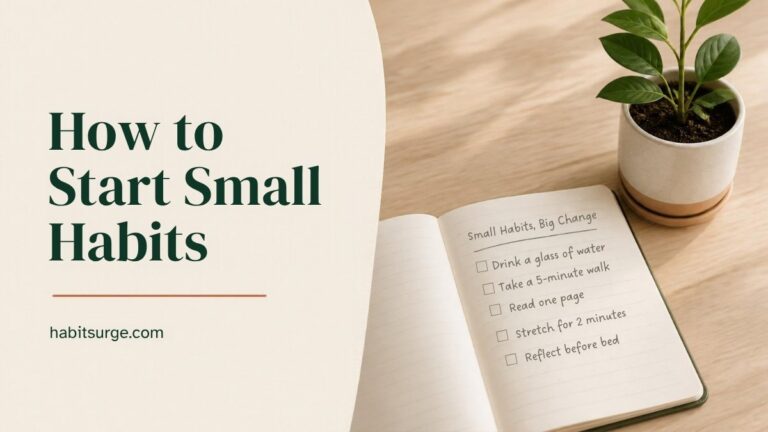
- Meditation habit → MVA: Sit in your meditation spot for 2 minutes
- Exercise habit → MVA: Put on workout clothes and do 5 minutes
- Reading habit → MVA: Open the book and read one page
- Journaling habit → MVA: Write one sentence
On hard days, you do the MVA and count it as a win. On good days, you go further. But the streak never breaks.
Related: How to start small habits that actually stick
Step 2: Energy Mapping
Schedule your habits around your biology, not an arbitrary time slot.
Energy levels are not random. Research on circadian rhythms shows that most people have predictable peaks and troughs in cognitive and physical energy throughout the day (Roenneberg, 2012, Internal Time). High-focus habits belong in your peak window. Low-effort habits belong in your trough.
A common mistake is picking a habit time based on what sounds disciplined (5 AM) rather than what fits their actual energy profile. A night owl forcing a 5 AM habit is fighting their body clock every day, and that’s a fight you don’t need.
To energy map your habits:
- Track your energy level hourly for 3 days (1–5 scale, no judgment)
- Identify your 2-hour peak window (usually 2–3 hours after natural wake time)
- Assign your hardest, most important habit to that window
- Assign secondary habits to your medium-energy periods
- Keep the low-energy periods free of anything requiring willpower
This often makes a new habit far easier to keep. Not because you’re trying harder, but because you stopped trying at the wrong time.
Step 3: Environment Design
Make the right behavior easier than the wrong one.
This is the single highest-leverage step in the entire framework. Behavioral economist Richard Thaler, who won the 2017 Nobel Prize in economics, showed with Cass Sunstein that small changes to how choices are presented can shift behavior without relying on willpower (Thaler & Sunstein, Nudge, 2008). Research on everyday habits points the same way: about 43% of daily behaviors are performed habitually, usually in the same context (Wood, Quinn & Kashy, 2002).
Environment design for habit building has two components:
Friction reduction (make the habit easier):
- Reading habit: Book on your pillow, not the shelf
- Exercise habit: Shoes by the door, clothes laid out the night before
- Water habit: Glass on the counter, not in the cupboard
- Journaling habit: Notebook on the desk, pen on top of it
Friction addition (make the competing behavior harder):
- Phone scrolling: Charger in another room at night
- TV watching: Remote in a drawer in a different room
- Snacking: Healthy food at eye level, junk food behind a closed door on a high shelf
You are not fighting yourself. You are redesigning your environment so the default behavior is the habit you want.
Related: How to build discipline without motivation
Step 4: The Comeback Rule
Never miss twice. One miss is an accident; two in a row starts a new (bad) habit.
This step is the most underrated in the system. Missing a day is not a habit failure. It is a completely normal, expected part of any habit-building process. In the UCL habit study, missing a single opportunity did not meaningfully affect the habit-formation process (Lally et al., 2010). What matters is that you return.
The Comeback Rule is simple: when you miss, the only rule is that you do not miss the next day. Even if “doing it” the next day means just the Minimum Viable Action from Step 1. Even if it’s the worst version of the habit. You do it.
This does three things:
- It removes the catastrophizing (“I ruined it”) that turns one miss into a collapse
- It maintains the identity signal to your brain: “I’m someone who does this”
- It keeps the environmental cues active so the habit hasn’t fully dissolved
One more nuance: resist the urge to “make up” for a missed day by doubling up the next day. That creates a punishing precedent that makes missing days feel even worse. The rule is return, not punishment.
Related: How to be consistent (even when you don’t feel like it)
Step 5: Streak-Proofing
Shift your identity from “I’m trying to build this habit” to “I’m someone who does this.”
Every habit eventually gets tested: travel, illness, a chaotic week, a life event that knocks everything sideways. Habits that survive these tests aren’t held together by streaks or motivation. They’re held together by identity.
James Clear articulates this clearly in Atomic Habits (2018): the most durable habits are ones tied to identity, not outcomes. “I’m trying to exercise” is fragile. “I’m someone who moves their body every day” is structurally different. The first is a goal. The second is who you are.
Streak-proofing means you stop defining success by the streak and start defining it by the identity. On a day when the streak breaks, you ask: “What would a person who takes care of their health do today?” Usually the answer is simple. Usually it’s just the MVA from Step 1.
Combined with the Comeback Rule, this step closes the loop. There is no “I failed.” There is only “I’m returning.”
Related: Why self-discipline is the highest form of self-respect
Applying Soft Discipline to Specific Habits
The five steps above work for any behavior. This is how they apply to the most common habit types:
Morning Routines
Common design problem: Creating a 90-minute morning routine when they’ve never had one. By day four, it’s a source of daily failure instead of daily momentum.
Soft Discipline application:
- MVA: one thing. Make coffee and take one quiet minute. That counts as a morning routine.
- Energy Map: Your peak window starts roughly 90 minutes after wake. Don’t schedule deep work before that.
- Environment: Coffee ready to brew the night before. Phone in another room.
- Comeback Rule: If you blow the morning, don’t try to “make up” the routine at 2 PM. Simply return tomorrow.
Need ideas? See these 10 tiny daily habits that transform your life.
Exercise Habits
Design problem: Committing to 5 workouts per week when you currently do zero.
Soft Discipline application:
- MVA: move for 5 minutes, even just a walk around the block.
- Environment: Gear visible. Gym bag by the door. Workout scheduled as a calendar event, not an intention.
- Identity: “I move my body daily,” not “I’m trying to get fit.”
Reading Habits
Design problem: Setting a goal of 30 pages per day when you haven’t read consistently in years.
Soft Discipline application:
- MVA: one page.
- Environment: Book in every location where you wait (nightstand, bag, desk).
- Energy Map: Reading in your low-energy afternoon trough is usually perfect: calm attention, no decision needed.
The One Habit Mistake That Destroys Everything
You can do everything in this guide and still fail if you rely on motivation to maintain it.
Motivation is a state, not a trait. It fluctuates daily, hourly, sometimes minute by minute. Building a habit system on motivation is like building a house on a tide. Some days you feel it; most days you don’t. The days you don’t are the days your system either holds or breaks.
Related: Process over outcome: the mindset shift of winners vs dreamers
The Soft Discipline Method doesn’t require motivation to function. On the days you feel motivated, you go beyond the MVA. On the days you don’t, you do exactly the MVA and move on. The system runs regardless.
That’s the whole design.
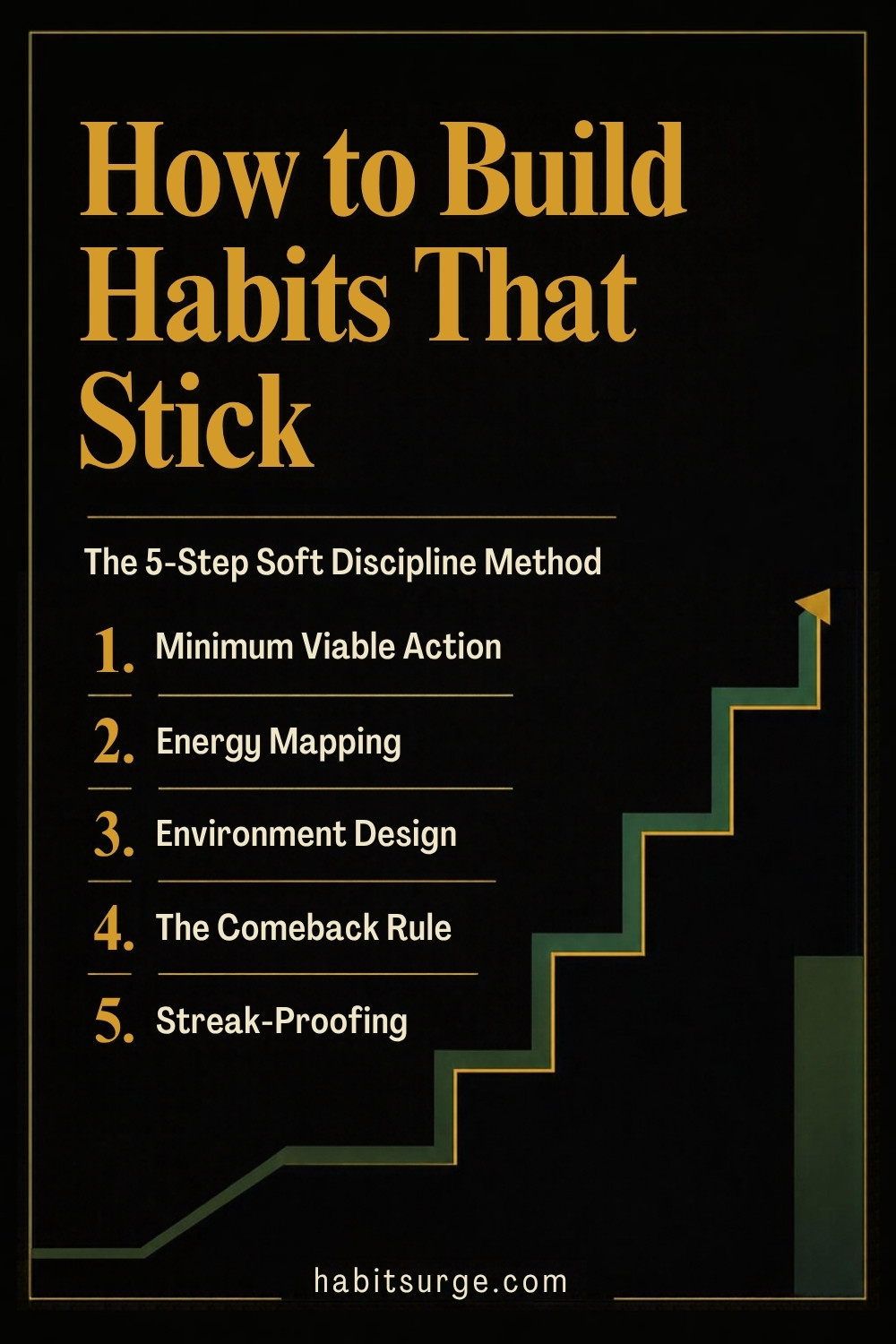
Save this for later: pin the image below to your Pinterest board.
More practical guides: habit stacking with 40 examples, 100 habits to track, and how to get back on track after you fall off.
Build your mornings: use this simple morning routine checklist for adults.
Frequently Asked Questions
How long does it actually take to build a habit?
Research from University College London (Lally et al., 2010) found that habits take between 18 and 254 days to form, with an average of 66 days. This varies significantly based on the complexity of the behavior and individual differences. The 21-day rule is a myth popularized without scientific backing. Plan for 60–90 days before a habit feels automatic.
What if I keep breaking my habits no matter what I try?
Apply the diagnostic: which of the four design failures is your habit hitting? Is the threshold too high (fix: reduce to MVA)? Is the environment fighting you (fix: redesign physical cues)? Is there no recovery protocol (fix: apply the Comeback Rule)? Is the reward too delayed (fix: add an immediate reward: a checkmark, a small treat, anything)? Most chronic habit failures trace to a design problem, not a character problem.
Does Soft Discipline work for people with ADHD or executive function challenges?
Environment design and the Minimum Viable Action are particularly effective for people with ADHD because they reduce the cognitive load of initiating behavior. The MVA removes the “starting problem,” and environmental cues reduce reliance on working memory. This isn’t a substitute for professional support, but these tools are consistent with ADHD behavioral interventions used in clinical settings.
How is this different from Atomic Habits by James Clear?
Soft Discipline shares conceptual ground with Atomic Habits, particularly around identity-based habits and environmental design. The difference is in the recovery system. Atomic Habits focuses on building the habit loop forward. Soft Discipline adds an explicit framework for what to do when the loop breaks, which it inevitably will. The Comeback Rule and Streak-Proofing steps are the additions that make the system resilient to real life.
Can I build multiple habits at once using this method?
Start with one. Get the MVA working, the environment designed, and the identity shift beginning. After 30 days, add a second habit. After another 30, a third. Stacking new habits on an existing one (habit stacking, as Fogg and Clear both describe) is efficient, but only once the base habit is stable. Trying to build three habits simultaneously from zero is almost always a design failure waiting to happen.
The Bottom Line
You don’t need more motivation. You don’t need to be harder on yourself. You need a better design.
The Soft Discipline Method gives you that design:
- Minimum Viable Action: set a floor so low you can always clear it
- Energy Mapping: schedule habits when your biology supports them
- Environment Design: make the right behavior the default
- The Comeback Rule: never miss twice
- Streak-Proofing: anchor your habits to identity, not streaks
Pick one habit and apply step one today.
Want a guided start? Get the free 7-Day Discipline Reset, one small action a day built on this method. Get the free guide here.
References
- Baumeister, R.F., Bratslavsky, E., Muraven, M., & Tice, D.M. (1998). Ego depletion: Is the active self a limited resource? Journal of Personality and Social Psychology, 74(5), 1252–1265.
- Clear, J. (2018). Atomic Habits. Avery/Penguin Random House.
- Fogg, B.J. (2019). Tiny Habits: The Small Changes That Change Everything. Houghton Mifflin Harcourt.
- Wood, W., Quinn, J. M., & Kashy, D. A. (2002). Habits in everyday life: Thought, emotion, and action. Journal of Personality and Social Psychology, 83(6), 1281–1297.
- Lally, P., van Jaarsveld, C.H.M., Potts, H.W.W., & Wardle, J. (2010). How are habits formed: Modelling habit formation in the real world. European Journal of Social Psychology, 40(6), 998–1009.
- Roenneberg, T. (2012). Internal Time: Chronotypes, Social Jet Lag, and Why You’re So Tired. Harvard University Press.
- Thaler, R.H., & Sunstein, C.R. (2008). Nudge: Improving Decisions About Health, Wealth, and Happiness. Yale University Press.
Published on HabitSurge.com | © 2026 HabitSurge